Agroforestry AF
About
Agroforestry systems intentionally integrate trees and shrubs with crops or livestock. Importantly, unmanaged woodlot grazing and single species orchards are not considered agroforestry practices. While agroforestry systems are more prevalent in tropical regions, temperate agroforestry systems include five USDA recognized agroforestry practices: alley cropping, forest farming, riparian forest buffers, silvopasture, and windbreaks. However, additional NRCS conservation practices can be stacked with USDA recognized agroforestry practices. When intentionally managed, agroforestry systems support long-term agricultural production and resilience.
Benefits
Depending on site conditions, previous land-use, and system design, agroforestry systems:
- Enhance soil health
- Protect crops and livestock
- Reduce inputs
- Increase biodiversity
- Diversify income
Challenges
Challenges of agroforestry systems include:
- Management complexity
- Resource competition
- Undeveloped markets
- Lack of structural support
Agroforestry Practices
The ACRE team evaluated various agroforestry practices for climate smartness. Below is a list of practices linked to the ACRE Portal.
- Alley Cropping: Plants crop alleys between tree or shrub rows for diverse yields.
- Composting Facility: Converts organic waste into stable compost through controlled decomposition.
- Conservation Cover: Establishes permanent vegetative cover to protect and restore the land.
- Contour Buffer Strips: Plants perennial vegetation strips along the contour to slow runoff.
- Critical Area Planting: Establishes permanent vegetation on erodible or disturbed land to stabilize soil.
- Field Border: Plants permanent vegetation strips around field edges to reduce erosion and support wildlife.
- Forest Farming: Grows understory crops beneath a managed forest canopy for income.
- Forest Stand Improvement: Alters forest stand composition, structure, or density to improve forest health.
- Fuel Breaks: Uses strips of reduced vegetation to slow wildfire spread and protect property.
- Grassed Waterways: Uses vegetated channels to safely convey runoff and prevent soil erosion.
- Mulching: Applies plant residue or other materials to bare soil to protect and improve it.
- No-Till: Leaves crop residue on the soil surface to minimize soil disturbance.
- Nutrient Management: Manages fertilizer rate, timing, placement, and source to reduce nutrient loss.
- Pasture and Hay Planting: Establishes perennial forage species for pasture and hay production.
- Prescribed Burning: Uses planned, controlled fire to manage vegetation and reduce risk.
- Prescribed Grazing: Manages timing and intensity of grazing to protect pasture health.
- Reduced Till: Limits soil disturbance during seedbed preparation while retaining protective residue cover.
- Riparian Forest Buffer: Plants trees and grasses along waterways to filter runoff and stabilize banks.
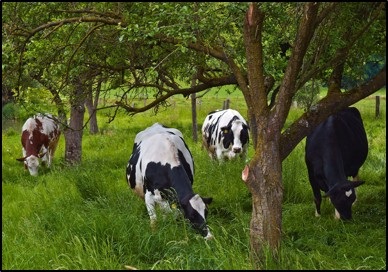
- Silvopasture: Integrates trees, forage, and livestock in one managed pasture system.
- Soil Carbon Amendment: Applies organic material to soil to improve health and store carbon.
- Tree/Shrub Establishment: Establishes woody plants through seeding, seedlings, cuttings, or natural regeneration.
- Vegetative Barriers: Plants narrow rows of perennial vegetation along contours to slow runoff and erosion.
- Wildlife Habitat Planting: Plants herbaceous vegetation and shrubs to create or restore wildlife habitat.
- Windbreaks: Uses linear tree and shrub plantings to reduce wind speed and protect farms.
Resources
- USDA: NRCS Conservation Practice Standards for Agroforestry
- USDA-FS National Agroforestry Center: Agroforestry Practices
- USDA-FS National Agroforestry Center: Agroforestry Publications
- University of Missouri Center for Agroforestry: Agroforestry Resources
- University of Missouri Center for Agroforestry: Using NRCS Assistance for Agroforestry and Woody Crop Establishment
- Savanna Institute: Technical Assistance
References
- Asprooth, L., Traldi, R., Arbuckle, J., Church, S., Floress, K., Gramig, B., ... & Prokopy, L. S. (2026). A framework for conceptualizing agricultural diversification with a focus on the US Corn Belt. Agricultural Systems, 238, 104826.
- Ma, Z., Chen, H. Y., Bork, E. W., Carlyle, C. N., & Chang, S. X. (2020). Carbon accumulation in agroforestry systems is affected by tree species diversity, age and regional climate: A global meta-analysis. Global Ecology and Biogeography, 29(10), 1817-1828.
- Nair, P. R., Kumar, B. M., & Nair, V. D. (2021). An introduction to agroforestry: four decades of scientific developments (pp. 1-649). Cham: Springer.
- Smith, M. M., Bentrup, G., Kellerman, T., MacFarland, K., Straight, R., & Ameyaw, L. (2022). Agroforestry extent in the United States: A review of national datasets and inventory efforts. Agriculture, 12(5), 726.
- Udawatta, R. P., & Gantzer, C. J. (2022). Soil and water ecosystem services of agroforestry. Journal of Soil and Water Conservation, 77(1), 5A-11A.