No-Till (NRCS #329)
Applicable Systems
About
No-till1 is a conservation tillage practice where farmers leave most previous crop residue on the soil surface year-round and crops are planted with minimal in-row soil disturbance. The practice can be implemented in all croplands to protect and rebuild soil natural structure.
Key aspects and considerations:
- Choose the tillage systems according to soil and crop type, slope, and climate.
- Enhance crop residues by using high residue crops and crop varieties, cover crops, double cropping, and adjustment of plant populations through seeding rates and row spacing.
- Distribute residue uniformly over the entire field, in a minimum of 60% cover.
- Maintain soil surface cover year-round with living vegetation to increase effectiveness.
- Do not burn residues.
- Adjust nutrient and pest management as needed.
- Become more profitable than tilled systems after initial implementation2.
- Partial budget estimates suggest net economic gains ranging from $13 to $121 per acre, depending on site and crop3.
Benefits and Limitations
| ACRE Category | Benefits | Limitations |
|---|---|---|
| Soil Health |
|
|
| Water Management |
|
|
| Nutrient Management |
|
|
| Agricultural Production |
|
|
| Biodiversity and Wildlife |
|
|
| GHG Emission |
|
|
| Economics |
|
|
Impact on Agricultural Resilience
- Increases plant resilience to drought and flooding due to improved water holding capacity and enhanced drainage.
- Generates cumulative improvements in soil function and yield resilience.
- Soil becomes healthier and recovers faster after disturbances.
Regional Applicability
- No-till systems are applicable across the Midwest, especially in row-crop agriculture. Over 30 years of research comparing no-till to conventional tillage in Kalamazoo County, Michigan, found that no-till systems accumulated more soil organic carbon than conventionally tilled soils, but with possible yield declines that may be overcome with delayed planting dates.
- Reducing tillage intensity improves biological soil health, with the maximum benefit observed with perennial systems or row crop systems under no-till across different agricultural production systems in the United States7.
Case Studies
- Larry Thorndyke and his family farm Thorndyke Farms in Ford County, Illinois, where they implement both no-till and strip-till on their corn and soybean fields. The Thorndyke family has witnessed improvements in water holding capacity, aggregate stability, and earthworm activity after implementing multiple soil health practices.
- In the Upper Scioto Watershed in Ohio, Eric Niemeyer of MadMax Farms adopted soil health practices, including no-till, with a goal to "make dead soil alive again." Eric found that by implementing no-till, he was able to reduce labor and machinery costs, allowing him to upgrade his planter.
- In Logan County, Ohio, Tim Lyden transitioned Lyden Farms to no-till in 2016 to combat soil erosion. Describing his decision, Tim states, "It's just like a lightbulb went off. I'd kind of been doing stuff the wrong way."
- Get to know how Ray Gaesser maintains and improves his cropland in Iowa with healthy soil management. "Water infiltration tests show Ray's fields can absorb an inch of water in two to three seconds. Comparable fields with a history of tillage take seven to eight minutes to absorb that much water."
Resources
- Video. USDA NRCS: The USDA NRCS -- No Till
- Video. USDA NRCS South Dakota: No-Till Seeding Concepts
- Clean Water Iowa: No-Till / Strip-Till
- Ohio State University Extension: AgBMPs. Tillage Intensity to Maintain Target Residue Cover (NRCS 329, 345 & 346)
- University of Missouri Extension: Missouri No-Till Planting Systems
- U.S. Nature4Climate: No-Till Agriculture Challenges and Opportunities
References
- USDA-NRCS (2016). Conservation Practice Standard Document, Residue and Tillage Management, No-Till, Code 329. https://www.nrcs.usda.gov/sites/default/files/2022-09/Residue_And_Tillage_Management_No_Till_329_CPS_0.pdf
- Cusser, S., Bahlai, C., Swinton, S. M., Robertson, G. P., & Haddad, N. M. (2020). Long-term research avoids spurious and misleading trends in sustainability attributes of no-till. Global Change Biology, 26, 3715--3725. https://doi.org/10.1111/gcb.15080
- Zhang, Y., Rejesus, R. M., Cavigelli, M. A., et al. (2025). Long-Term Economic Impacts of No-Till Adoption in the US Midwest. 2025 AAEA & WAEA Joint Annual Meeting. https://doi.org/10.22004/ag.econ.361069
- Basso, B., Cates, A., Jianwei L., J., Brewer, K., Tiemann, L., & Millar, N. (2025). Soil Health and Climate Outcomes: Literature Review and Technical Guidance. Technical Advisory Network for Climate Smart Agricultural Practices, June 30. https://doi.org/10.5281/zenodo.17534271
- Gelfand, I., Sahajpal, T., Zhang, X., Izaurralde, R. C., Gross, K. L., & Robertson, G. P. (2013). Sustainable Bioenergy Production from Marginal Lands in the US Midwest. Nature, 493, 514--517. https://doi.org/10.1038/nature11811
- Chen, L., Rejesus, R. M., Aglasan, S., Hagen, S., & Salas, W. (2023). The Impact of No-Till on Agricultural Land Values in the United States Midwest. American Journal of Agricultural Economics, 105(3), 760--783. https://doi.org/10.1111/ajae.12338
- Nunes, M. R., Karlen, D. L., Veum, K. S., Moorman, T. B., & Cambardella, C. A. (2020). Biological Soil Health Indicators Respond to Tillage Intensity: A US Meta-Analysis. Geoderma, 369, 114335. https://doi.org/10.1016/j.geoderma.2020.114335
- Michigan State University Extension (2024). Lessons from Long Term Research: Comparing No-Till to Conventional Tillage Over 30 Years. https://www.canr.msu.edu/soil_health/uploads/files/NoTill%20Bulletin%20final%202025.pdf
- Miller, T. P., Peterson, J. R., Lenhart, C. F. & Nomura, Y. (2012). The Agricultural BMP Handbook for Minnesota. Minnesota Department of Agriculture, p.94-98. https://wrl.mnpals.net/_flysystem/fedora/2023-09/the-agricultural-bmp-handbook-for-minnesota.pdf#page=95
- University of Missouri Extension (1997). Missouri No-Till Planting System. https://extension.missouri.edu/publications/m164
- USDA-NRCS (2016). Conservation Practice Overview, Residue and Tillage Management, No-Till (Code 329). https://www.nrcs.usda.gov/sites/default/files/2022-09/Residue_And_Tillage_Management_No_Till_329_PO_Sep_2016_0.pdf
- Wongpiyabovorn, O., & Wang, T. (2025). Changes in Adoption Patterns of Beginning and Long-term No-Till Adopters. RaFF Policy Brief 2025-3(2), Rural and Farm Finance Policy Analysis Center, University of Missouri-Columbia. https://raff.missouri.edu/wp-content/uploads/2025/03/2025-32-RaFF-Policy-Brief.pdf/
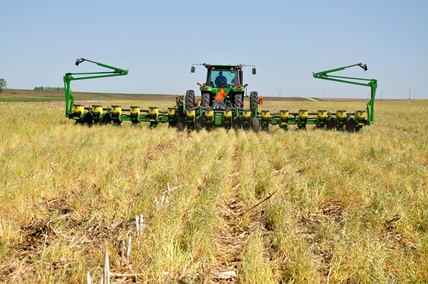
Photo 1: Planter operating in a no-till cereal rye field.
Courtesy of Iowa NRCS photo by Jason Johnson.
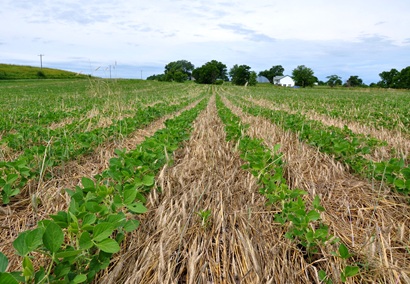
Photo 2: No-till field with crimp-rolled cereal rye and soybeans.
Courtesy of Iowa NRCS photo by Jason Johnson.
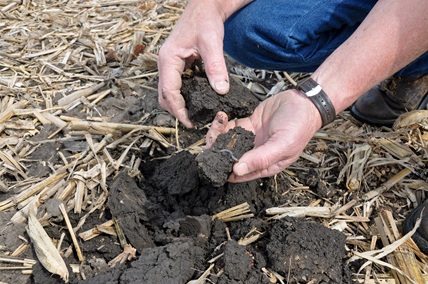
Photo 3: Farmer in an Iowa no-till field showing the soil biology.
Courtesy of Iowa NRCS photo by Jason Johnson.