Riparian Forest Buffer (NRCS #391)
Applicable Systems
About
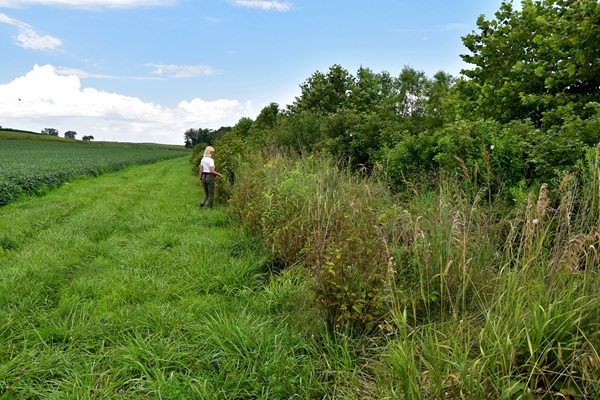
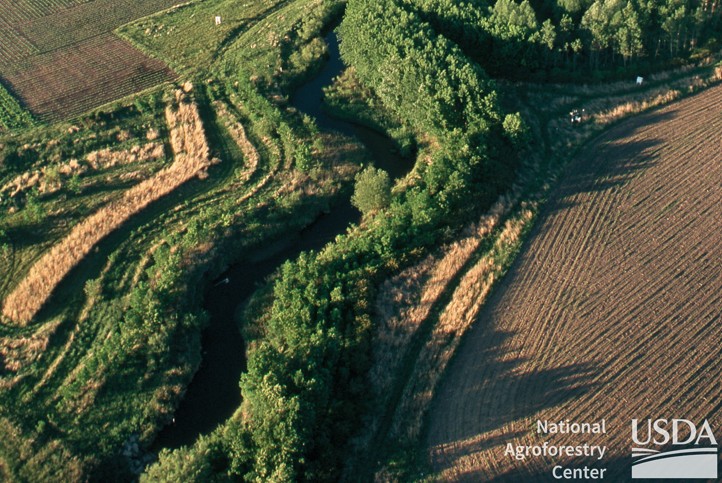
Riparian forest buffers are an edge of field agroforestry practice, in which trees and grasses are planted alongside waterways, and serve to increase infiltration and reduce runoff, sediment, and nutrients from cropland to nearby waterways1 2. Site conditions and land manager goals will help determine the most effective buffer location, size, and design.
Key aspects and considerations:
- Riparian forest buffers are often planted in zones. For best management, each zone should follow appropriate guidelines in terms of width, species planted, depth to water table, and desired goals.
- Zone 1: In the area closest to the body of water, plant native perennial species and limit disturbance.
- Zone 2: If desired, integrate tree production in this zone, ensure selected trees and grasses are flood tolerant.
- Zone 3: In the zone closest to cropland, plant grasses or forbs to increase infiltration and trap sediment.
Benefits and Limitations
| ACRE Category | Benefits | Limitations |
|---|---|---|
| Soil Health |
|
|
| Water Management |
|
|
| Nutrient Management |
|
|
| Agricultural Production |
|
|
| Biodiversity and Wildlife |
|
|
| GHG Emission |
| |
| Economics |
|
|
Impact on Agricultural Resilience
- Riparian forest buffers improve infiltration and reduce discharge to groundwater, mitigating the impacts of extreme rainfall and reducing the risk of flooding11. Rainfall intensity is projected to increase across Wisconsin, as well as much of the Midwest. Riparian forest buffers offer a strategy to adapt to changing rainfall patterns and prevent further soil loss.
- By providing shade, riparian forest buffers moderate the impact of increased air temperatures on stream temperature, which benefits aquatic life.
Regional Applicability
- Riparian forest buffers are applicable across the United States, but only on land that is adjacent to a river, stream, or water body. Depending on the region, riparian forest buffers can take on various characteristics.
- In the Midwest, riparian forest buffers often must be reestablished on cropland, while in the eastern region of the U.S., riparian forest buffers may exist as remnant forests12. In the Corn Belt, riparian forest buffers typically cover 16 acres per farm, for those who report using agroforestry practices10.
- Based on environmental suitability mapping, priority areas for riparian buffer establishment include Indiana, Iowa, Nebraska, and central Illinois13.
- In the Midwest and beyond, planting riparian forest buffers can help landowners meet laws and regulations. Specifically, the Minnesota buffer law requires perennial buffers adjacent to public streams, lakes, and rivers. Demonstration farms featuring riparian forest buffers are found at Riveredge Nature Center and the South Farm at Savanna Institute's Spring Green Campus, both located in Wisconsin.
Case Studies
- In Pennsylvania, Deanne Boyer, the farmer and owner of Willow Run Farmstead LLC, describes their motivation for planting a riparian forest buffer: "...over the summer months, what we're seeing is instead of steady rainfalls over a longer period of time, we get downpours... It's hard on the soil because it's either dry or it's getting pummeled. So I feel like it's important for me to start thinking about shifting to a way that does protect the soil more."
Resources
- Video. USDA-NRCS: Riparian Forest Buffer
- Video. USDA Northeast Climate Hub: Riparian Buffers
- Video. Savanna Institute: Riparian Forest Buffers | 5 Agroforestry Practices Explained
- Podcast. Savanna Institute Perennial AF: The Pros and Cons of Windbreaks and Riparian Buffers
- USDA-FS: Riparian Buffer Design Guidelines Case Study
- University of Missouri Center for Agroforestry: Establishing and Managing Riparian Forest Buffers
- Clean Water Iowa: Stream Buffers
- University of Wisconsin-Madison Division of Extension: Riparian Buffers - Agroforestry for Any Property
- USDA-FS National Agroforestry Center and Savanna Institute: Multifunctional Buffers: Design Guidelines for Buffers, Corridors, and Greenways
- USDA-FS National Agroforestry Center: Conservation Buffers: Design Guidelines for Buffers, Corridors, and Greenways
- USDA-FS National Agroforestry Center: What is a Riparian Forest Buffer?
- USDA-FS National Agroforestry Center: Buffer$ A Conservation Buffer Economic Analysis Tool
- USDA-FS National Agroforestry Center: Non-timber Forest Product Calculator (NTFP)
- USDA-FS National Agroforestry Center: Riparian Forest Buffers: An Agroforestry Practice
- USDA-NRCS: Riparian Forest Buffer Wisconsin Guidance Document
- USDA-NRCS: Riparian Forest Buffer (Ac.) (391) Conservation Practice Standard
References
- USDA-NRCS (2020). Conservation Practice Standard Document, Riparian Forest Buffer, Code 391. https://www.nrcs.usda.gov/sites/default/files/2022-09/Riparian_Forest_Buffer_391_CPS_10_2020.pdf
- USDA-NRCS (2020). Conservation Practice Overview, Riparian Forest Buffer, Code 391. https://www.nrcs.usda.gov/sites/default/files/2022-09/Riparian_Forest_Buffer_391_Overview_10_2020.pdf
- Hernandez-Santana, V., Asbjornsen, H., Sauer, T., Isenhart, T., Schilling, K., & Schultz, R. (2011). Enhanced transpiration by riparian buffer trees in response to advection in a humid temperate agricultural landscape. Forest Ecology and Management, 261(8), 1415-1427.
- Zhu, X., Liu, W., Chen, J., et al. (2020). Reductions in water, soil and nutrient losses and pesticide pollution in agroforestry practices: a review of evidence and processes. Plant and Soil, 453, 45-86. https://doi.org/10.1007/s11104-019-04377-3
- Zaimes, G. N., Schultz, R. C., & Isenhart, T. M. (2004). Stream bank erosion adjacent to riparian forest buffers, row-crop fields, and continuously-grazed pastures along Bear Creek in central Iowa. Journal of Soil and Water Conservation, 59(1), 19-27.
- Dala-Corte, R. B., Giam, X., & Wilcove, D. S. (2026). Assessing the effectiveness of riparian buffers in protecting biodiversity: a meta-analysis. Nature Communications, 17(1), 4155.
- Reves, O. P., Davis, M. A., Iacaruso, N. J., & Larson, E. R. (2025). Environmental DNA quantifies the terrestrial biodiversity co-benefit of forested riparian buffers in agricultural landscapes. Journal of Applied Ecology, 62(12), 3469-3479.
- Kim, D. G., & Isaac, M. E. (2022). Nitrogen dynamics in agroforestry systems: a review. Agronomy for Sustainable Development, 42, 60. https://doi.org/10.1007/s13593-022-00791-7
- Lawrence, N., Ahamed, A., Conway, A., Covey, K., Chenyang, L., Machado, S., Wardropper, C., Stutzman, E., & Mize, C. (2025). Agroforestry and Climate Outcomes: Literature Review and Technical Guidance. Technical Advisory Network for Climate Smart Agricultural Practices. https://doi.org/10.5281/zenodo.15776654
- Smith, M. M., Floress, K., Bentrup, G., et al. (2026). Riparian forest buffers in the United States: Results from the National Agroforestry Producer Survey. Agroforestry Systems, 100, 183. https://doi.org/10.1007/s10457-026-01537-0
- Schoeneberger, M. M., & Bentrup, G. (2017). Agroforestry: enhancing resiliency in US agricultural landscapes under changing conditions. Gen. Tech. Report WO-96. Washington, DC: US Department of Agriculture, Forest Service, 96.
- Schultz, R. C., Isenhart, T. M., Simpkins, W. W., & Colletti, J. P. (2004). Riparian forest buffers in agroecosystems -- lessons learned from the Bear Creek Watershed, central Iowa, USA. Agroforestry Systems, 61, 35-50. https://doi.org/10.1023/B:AGFO.0000028988.67721.4d
- Castle, S. E., Miller, D. C., & Wardropper, C. B. (2025). Mapping the social-ecological suitability of agroforestry in the US Midwest. Environmental Research Letters, 20(2), 024041.