Silvopasture (NRCS #381)
Applicable Systems
About
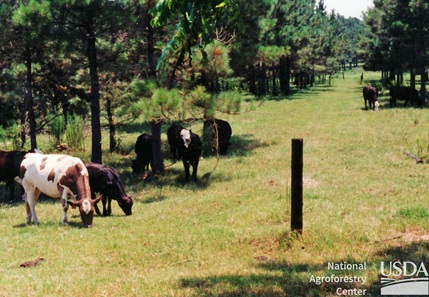
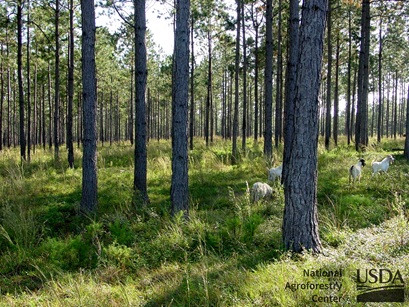
Silvopasture, an agroforestry practice, integrates trees, forage, and livestock within one site or operation through intentional management. Silvopasture can be established by adding trees to a pasture, or by removing trees from a forest or woodlot. By implementing silvopasture, trees protect livestock from the wind and provide shade. More broadly, silvopasture benefits include improved forage quality, reduced erosion, decreased soil erosion, and improved habitat1 2. Silvopasture systems are suitable for grazing dairy and beef cattle, sheep, goats, and poultry, and promote short-term economic revenue from grazing while trees mature.
Key aspects and considerations:
- Use intentional, intensive, interactive, and integrated management.
- Avoid overgrazing; consider rotational grazing practices.
- During establishment, protect trees from livestock.
- Ensure adequate water availability.
- Plant species suitable to the climate and site characteristics.
- Ensure adequate grazing length and rest periods.
- Plan for changes in canopy cover.
- Consider equipment availability in management plans.
Benefits and Limitations
| ACRE Category | Benefits | Limitations |
|---|---|---|
| Soil Health | ||
| Water Management |
|
|
| Nutrient Management |
|
|
| Agricultural Production |
| |
| Biodiversity and Wildlife |
| |
| GHG Emission |
|
|
| Economics |
|
|
Impact on Agricultural Resilience
- Silvopasture provides shade for livestock, helping to maintain animal wellbeing and productivity as extreme heat becomes more prevalent in portions of the Midwest. Additionally, as nighttime temperatures rise and limit livestock's ability to cool down, shade and protection provided by silvopasture systems will further enhance livestock wellbeing. Silvopasture also provides wintertime benefits, as trees help buffer against wind and reduce windchill15.
- Greater soil organic matter and resulting increases in water holding capacity may make silvopasture more resilient to drought and flooding than open pasture systems.
Regional Applicability
- Silvopasture is predominantly practiced in the west and southeast United States11, though it remains applicable to the Midwest. In particular, the Midwest contributes substantially to U.S. livestock production, including dairy and beef cattle showcasing opportunities for silvopasture systems. According to a recent USDA survey of agroforestry producers, silvopasture was practiced by roughly 20-60% of respondents in the Midwest16. Silvopasture demonstration farms can be found in Wisconsin and Illinois through the Savanna Institute.
- However, unmanaged grazing of woodlots historically has left some across the Midwest region skeptical of silvopasture17. Importantly, silvopasture requires intentional integration and management to avoid overgrazing, making it distinctly different than woodlot grazing. Considering projected changes in rainfall patterns and an increase in extreme heat across the Midwest, silvopasture is a regionally relevant tool to increase drought tolerance in pasture while promoting livestock wellbeing.
Case Studies
- Deanne Boyer, the farmer and owner of Willow Run Farmstead LLC in Pennsylvania describes the decision to implement silvopasture: "The animal wellness [component of agroforestry] really does impact my bottom line in a lot of ways. A lot of my silvopasture choices are for animal wellness, which then creates better product, which then helps me financially."
- In Indiana, Nate and Liz Brownlee of Nightfall Farm converted their pasture to silvopasture after experiencing dangerous temperatures. A handful of years later, Nate reflects, "I can't imagine working with animals on a pasture that didn't have trees, now."
- In Virginia, a farmer decided to implement silvopasture after witnessing his cattle crowd around a few individual trees in the pasture. While relatively satisfied with silvopasture performance on his farm, the farmer emphasized his desire for more research on the best management practices for silvopasture systems.
- In Goleta, California, Guner and Heidi Tautrim decided to add trees to their pasture after recognizing the hurdles of trying to raise pigs and chickens in a drought prone region. During establishment, they faced challenges with protecting trees from animals, establishing water infrastructure, and limited technical assistance for mediterranean environments. However, they look forward to the added shade and shelter, and to diversifying their revenue streams.
Resources
- Video. Cornell University Small Farms Program: What is Silvopasture?
- Video. Farming with Trees: Silvopasture Series: Episode 1 Introduction
- Savanna Institute Perennial AF Podcast episode: Rusted Plowshare Farm Tour with Josh Payne
- University of Wisconsin Extension: Introduction to Silvopasture
- University of Minnesota Extension: Silvopasture
- North Carolina State Extension: Silvopastures: Forage Productivity and Microclimate
- Sustainable Farming Association. Webinar: Silvopasture in the Midwest
- University of Missouri Center for Agroforestry: Silvopasture Training Manual
- USDA-FS: Silvopasture Case Studies in North Carolina and Virginia
- USDA-FS National Agroforestry Center: Silvopasture: An Agroforestry Practice
- USDA-FS National Agroforestry Center: Mitigating Heat Stress in Cattle
- USDA-FS National Agroforestry Center: Silvopasture
- USDA-NRCS: Silvopasture (Ac.) (381) Conservation Practice Standard
References
- USDA-NRCS (2016). Conservation Practice Standard Document, Silvopasture, Code 381. https://www.nrcs.usda.gov/sites/default/files/2022-09/Silvopasture-381-CPS-May-2016.pdf
- USDA-NRCS (2016). Conservation Practice Overview, Silvopasture, Code 381. https://www.nrcs.usda.gov/sites/default/files/2022-09/Silvopasture-381-Overview-May-2016.pdf
- Amorim, H. C., Ashworth, A. J., O'Brien, P. L., et al. (2023). Temperate silvopastures provide greater ecosystem services than conventional pasture systems. Scientific Reports, 13, 18658. https://doi.org/10.1038/s41598-023-45960-0
- Orefice, J., Smith, M. M., Weinberg, W. C., & Batcheler, M. (2025). Carbon dynamics of silvopasture systems in the Northeastern United States. Scientific Reports, 15(1), 6995.
- De Stefano, A., & Jacobson, M. G. (2018). Soil carbon sequestration in agroforestry systems: a meta-analysis. Agroforestry Systems, 92(2), 285-299.
- Mayerfeld, D., Keeley, K. O., Rickenbach, M., Rissman, A., & Ventura, S. J. (2023). Evolving conceptions of silvopasture among farmers and natural resource professionals in Wisconsin, USA. Frontiers in Sustainable Food Systems, 7, 983376. https://doi.org/10.3389/fsufs.2023.983376
- Mayerfeld, D., Kruger, E., Gildersleeve, R., & Rickenbach, M. (2022). Impacts of different grazing approaches on woodland ecosystem properties. Agroforestry Systems, 96(3), 527-540.
- Pent, G. J., & Fike, J. H. (2021). Enhanced ecosystem services provided by silvopastures. In Agroforestry and Ecosystem Services (pp. 141-171). Cham: Springer International Publishing.
- Smith, M. M., Bentrup, G., Kellerman, T., MacFarland, K., Straight, R., Ameyaw, L., & Stein, S. (2022). Silvopasture in the USA: A systematic review of natural resource professional and producer-reported benefits, challenges, and management activities. Agriculture, Ecosystems & Environment, 326, 107818. https://doi.org/10.1016/j.agee.2021.107818
- Beillouin, D., Ben-Ari, T., Malézieux, E., Seufert, V., & Makowski, D. (2021). Positive but variable effects of crop diversification on biodiversity and ecosystem services. Global Change Biology, 27(19), 4697-4710.
- Udawatta, R. P., & Jose, S. (2012). Agroforestry strategies to sequester carbon in temperate North America. Agroforestry Systems, 86, 225-242. https://doi.org/10.1007/s10457-012-9561-1
- Lawrence, N., Ahamed, A., Conway, A., Covey, K., Chenyang, L., Machado, S., Wardropper, C., Stutzman, E., & Mize, C. (2025). Agroforestry and Climate Outcomes: Literature Review and Technical Guidance. Technical Advisory Network for Climate Smart Agricultural Practices. https://doi.org/10.5281/zenodo.15776654
- Prieto, J., Lin, Z., Reed, K. F., Wolf, C. A., & Ortiz-Bobea, A. (2026). Milk composition responses amplify economic damages from heat stress. Environmental Research Letters.
- Batcheler, M., Smith, M. M., Swanson, M. E., Ostrom, M., & Carpenter-Boggs, L. (2024). Assessing silvopasture management as a strategy to reduce fuel loads and mitigate wildfire risk. Scientific Reports, 14(1), 5954.
- Schoeneberger, M. M., & Bentrup, G. (2017). Agroforestry: enhancing resiliency in US agricultural landscapes under changing conditions. Gen. Tech. Report WO-96. Washington, DC: US Department of Agriculture, Forest Service, 96.
- Smith, M. M., Floress, K., Batcheler, M., Bentrup, G., MacFarland, K., Kellerman, T., & Ameyaw, L. (2026). Silvopasture in the United States: Results from the National Agroforestry Producer Survey. Agroforestry Systems, 100(6), 142.
- Mayerfeld, D., Rickenbach, M., & Rissman, A. (2016). Overcoming history: attitudes of resource professionals and farmers toward silvopasture in southwest Wisconsin. Agroforestry Systems, 90, 723-736. https://doi.org/10.1007/s10457-016-9954-7