Reduced Till (NRCS #345)
Applicable Systems
About
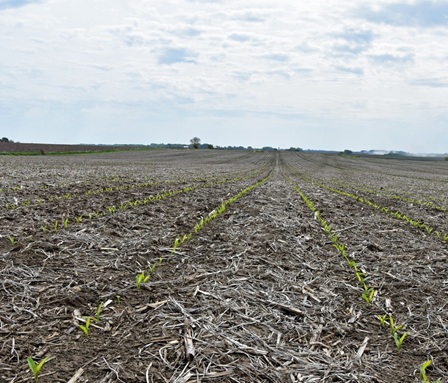
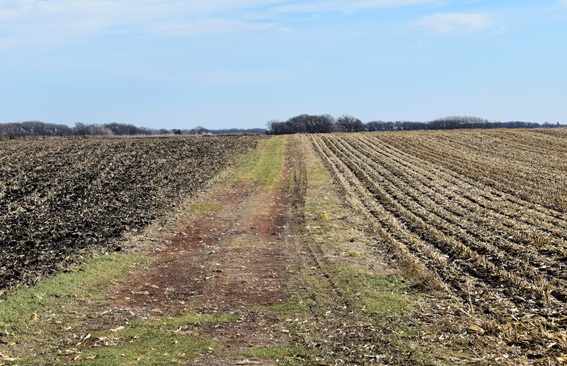
Reduced till1 is a conservation tillage practice in which crop and other plant residue on the soil surface are managed year-round with relatively minimal soil disturbance during seedbed preparation and crop establishment. Reduced tillage is often referred to as minimum tillage, which includes strip-till, ridge-till, and mulch-till, among others. Tillage is usually limited to the strip row, and residue left on the ground serves as mulch to protect the soil.
Key aspects and considerations:
- Use discs and tines to limit soil disturbance to shallow depths (2-4 inches).
- Reduce tillage operations or number of field passes.
- Maintain at least 30% residue cover.
- Remove residues from row area prior to planting if needed.
- Distribute residues uniformly across the field.
- Ensure adequate amounts of residue are produced.
- Cultivate multiple crops in rotation.
- Maintain year-round coverage with living vegetation.
- Do not burn residues.
- Consider implementing no-till in combination with additional conservation practices.
Benefits and Limitations
| ACRE Category | Benefits | Limitations |
|---|---|---|
| Soil Health |
|
|
| Water Management |
|
|
| Nutrient Management |
|
|
| Agricultural Production |
|
|
| Biodiversity and Wildlife |
|
|
| GHG Emission |
|
|
| Economics |
|
|
Impact on Agricultural Resilience
- Increases plant resilience to drought and flooding due to increased water holding capacity and enhanced drainage.
- Generates cumulative improvements in soil function and yield resilience.
- Soil becomes healthier and recovers faster after disturbances.
Regional Applicability
- Reductions in tillage intensity, combined with higher crop yields and better equipment, can contribute to sustained increases in soil organic carbon in the US Midwest4.
- A framework based on satellite imagery and machine learning to monitor conservation tillage practices was developed by researchers at the University of Illinois Urbana-Champaign. The new technology will help to monitor conservation practices over large areas for long periods of time.
- A study with data collected from seven farmers across the Midwest reported that reduced tillage had reduced operating costs and increased economic returns for corn and soybeans in comparison to conventional tillage. The return for corn averaged $377/acre for reduced tillage and $324/acre for conventional tillage, and returns for soybeans averaged $251/acre for reduced tillage compared to $216/acre for conventional tillage.
Case Studies
- Todd Ballard, a farmer in Kimberly, Idaho, reduced soil tilling on his farming system to maximize soil health benefits and reduce costs. "We believe in soil health practices because we see firsthand the difference it makes for our crops and bottom line."
Resources
- Video. NCAT ATTRA: NRCS Practice 345. Reduced Tillage
- Ohio State University Extension: AgBMPs. Tillage Intensity to Maintain Target Residue Cover (NRCS 329, 345 & 346)
- Research for Agriculture: No-Till and Reduced Tillage Farming: Revolutionizing Modern Agriculture Through Sustainable Soil Management
- Stanford University, Science and Engineering: Reduced soil tilling helps both soils and yields, Stanford researchers find
- The booklet Residue Management Choices: A Guide to Managing Crop Residues in Corn and Soybeans helps producers get started by pointing out some common tillage systems and answering some questions when getting started.
References
- USDA-NRCS (2016). Conservation Practice Standard Document, Residue and Tillage Management, Reduced Till, Code 345. https://www.nrcs.usda.gov/sites/default/files/2022-09/Residue_And_Tillage_Management_Reduced_Till_345_CPS.pdf
- Basso, B., Cates, A., Li, J., Brewer, K., Tiemann, L., & Millar, N. (2025). Soil Health and Climate Outcomes: Literature Review and Technical Guidance. Technical Advisory Network for Climate Smart Agricultural Practices. https://doi.org/10.5281/zenodo.17534271
- Gelfand, I., Sahajpal, R., Zhang, X., Izaurralde, R. C., Gross, K. L., & Robertson, G. P. (2013). Sustainable bioenergy production from marginal lands in the US Midwest. Nature 493, 514-517. https://doi.org/10.1038/nature11811
- Joshi, D. R., Clay, D. E., Alverson, R., Clay, S. A., Westhoff, S., Johnson, J. M. F., Wang, T., & Sieverding, H. (2025). Tillage intensity reductions when combined with yield increases may slow soil carbon saturation in the central United States. Scientific Reports 15, 10697. https://doi.org/10.1038/s41598-025-95388-x
- Adam, B. (2023). Minimum tillage as climate-smart agriculture practice and its impact on food and nutrition security. PLOS ONE. https://doi.org/10.1371/JOURNAL.PONE.0287441
- Miller, T.P., Peterson, J.R., Lenhart, C.F. & Nomura, Y. (2012). The Agricultural BMP Handbook for Minnesota. Minnesota Department of Agriculture, p.94-98. https://wrl.mnpals.net/_flysystem/fedora/2023-09/the-agricultural-bmp-handbook-for-minnesota.pdf#page=95
- USDA-NRCS (2016). Conservation Practice Overview, Residue and Tillage Management, Reduced Till (Code 345). https://www.nrcs.usda.gov/sites/default/files/2022-09/Residue_And_Tillage_Management_Reduced_Till_345_PS_Sept_2016.pdf
- USDA Natural Resources Conservation Service and University of Wisconsin-Extension (2000). Residue Management Choices: A Guide to Managing Crop Residues in Corn and Soybeans. https://mssoy.org/sites/default/files/documents/crop-residues-uwex-nrcs.pdf