Prescribed Grazing (NRCS #528)
Applicable Systems
About
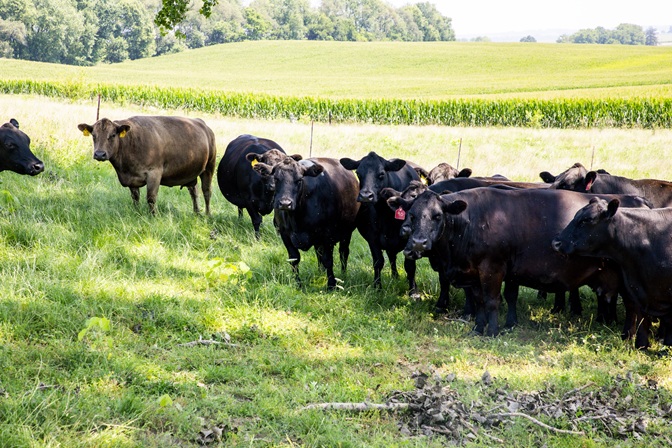
Prescribed grazing1 involves managing the frequency, duration, and intensity of grazing, while considering environmental, economic, and management objectives. The aim of this practice is to improve the health and productivity of pasture systems and rangelands while protecting the ecosystem. It can also be referred to as managed or rotational grazing.
Key aspects and considerations:
- Remove forage must consider limitations of production at each site and the animals' nutritional needs.
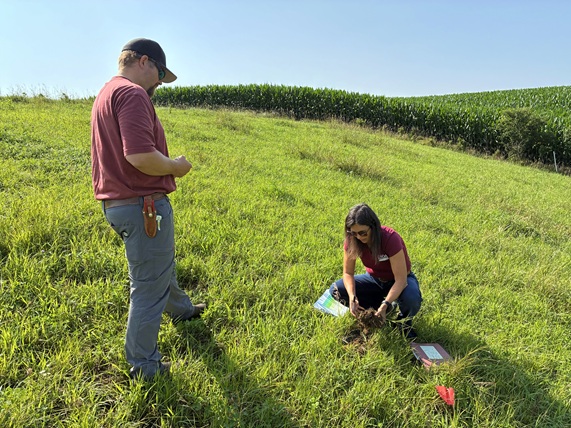
- Use soil tests to determine plant nutritional needs.
- Allow forage to recover by removing cattle from grazing areas.
- Balance livestock with available feed and forage.
- Manage livestock concentration to avoid overgrazing.
Benefits and Limitations
| ACRE Category | Benefits | Limitations |
|---|---|---|
| Soil Health |
|
|
| Water Management |
|
|
| Nutrient Management |
|
|
| Agricultural Production |
|
|
| Biodiversity and Wildlife |
|
|
| GHG Emission |
|
|
| Economics |
|
|
Impact on Agricultural Resilience
- Forage persistence increases during dry periods due to improved soil structure, increased water holding capacity, and deep roots.
- Productivity and water availability are more stable over time.
- Decreases flooding and soil loss during heavy rainfalls.
- Reduces need for irrigation, as well as associated energy.
Regional Applicability
- Forest & Natural Resources from Purdue Extension shows how Goat Grazing Could Be Option for Invasive Species Removal in the understory of timber stands in Southern Indiana.
- The study Soil Health in Relation to Grazing conducted by North Dakota State University (NDSU) Central Grassland Research Extension Center demonstrates the benefits of several grazing management approaches to soil health and pasture quality.
Case Studies
- Find out why Nicole Vernon was named the Iowa Conservation Woman of the Year (2025) by the Iowa Conservation Partnership. Nicole adopts several conservation practices to improve soil and water, among them rotational grazing with cover crops. "We seed rye into our row crops after chopping silage, which helps with ground cover and provides grazing for our cows in the fall and spring," she said.
- Kayla Koether and Landon Corlett raise goats in Iowa. They use prescribed grazing to manage degraded pastures and overgrown prairies. "Contract grazing would help us diversify our sources of income, pay for our grazing labor and provide cash flow to help us slowly grow our herd of cattle over time. Then we won't have to stock our operation by buying cattle outright," Kayla says.
- In Iowa, Adam Ledvina adopts prescribed grazing while using goats to manage brush and restore prairie. Adam's brush management business has allowed him to expand his herd size, and his goats have been hired to help clear brush at city parks. Adam describes some highlights of the business to Practical Farmers of Iowa (PFI), stating, "My favorite part about using the goats for conservation is seeing the difference they can make on a landscape without chemicals and machinery."
Resources
- Video. USDA NRCS: Prescribed Grazing
- Video. NCAT ATTRA: NRCS Practice 528. Prescribed Grazing
- Video. Illinois DNR: Prescribed Grazing: Rehabilitating Nature with Nature
- Canadian Forage and Grassland Association: Forage Best Management Practices for Enhancing Soil Organic Carbon Sequestration
- USDA-NRCS: Illinois Grazing Manual Fact Sheet
- Pasture Project at the Wallace Center: (1) Conservation Grazing on Public Land in the Upper Midwest; (2) Roadmap for Expanding Regenerative Grazing in Indiana
- Practical Farmers of Iowa (PFI): Grazing for Landowners: Livestock as a Tool for Land Management
- Rodale Institute: Rotational Grazing
- US Department of Interior, Bureau of Land Management (BLM): BLM launches new web tool to expand grazing opportunities and support healthier public lands
References
- USDA-NRCS (2017). Conservation Practice Standard Document, Prescribed Grazing, Code 528. https://www.nrcs.usda.gov/sites/default/files/2022-09/Prescribed_Grazing_528_CPS.pdf
- Jensen, K. L., Lambert, D. M., Clark, C. D., Holt, C., English, B. C., Larson, J. A., Yu, T. E., & Hellwinckel, C. (2015). Cattle Producers' Willingness to Adopt or Expand Prescribed Grazing in the United States. Journal of Agricultural and Applied Economics, 47(2), 213-242. https://doi.org/10.1017/aae.2015.6
- Messerges, O., & Ford, T. (2024). "What is Climate Smart Agriculture?" farmdoc daily, 14:128. Department of Agricultural and Consumer Economics, University of Illinois at Urbana-Champaign. https://farmdocdaily.illinois.edu/wp-content/uploads/2024/07/fdd071124.pdf
- Watts, J., Gennet, S., Knapp, C., Lavallee, J., Ritten, J., Hulvey, K., Nasto, M., Feldman, E., Willard, S., & Toureene, C. (2025). Grazing Lands Management Practices: An Assessment of Climate Outcomes. Technical Advisory Network for Climate Smart Agricultural Practices. https://doi.org/10.5281/zenodo.15750303
- Blanchet, K., Moechnig, H., & DeJong-Hughes, J. (2020). Grazing Systems Planning Guide. University of Minnesota Extension Service. 46p.
- Holley, K., Jensen, K. L., Lambert, D. M., & Clark, C. D. (2020). Bivariate MIMIC Analysis of Pasture Management and Prescribed Grazing Practices Used by Beef Cattle Producers. Journal of Agricultural and Resource Economics, 45(1), 56--77. https://www.jstor.org/stable/26869026
- NCAT, The National Center for Appropriate Technology. ATTRA Sustainable Agriculture. Prescribed Grazing: Central and Southern Appalachian Region. https://attra.ncat.org/wp-content/uploads/2024/02/prescribed-grazing-appalachia.pdf
- NYS Soil and Water Conservation Committee (2023). Agricultural Best Management Practice Systems Catalogue. https://extapps.dec.ny.gov/docs/water_pdf/agriculturebmp.pdf
- USDA-NRCS (2025). Conservation Practice Overview, Prescribed Grazing (Code 528). https://www.nrcs.usda.gov/sites/default/files/2025-07/528-nhcp-po-grazing-management-2025-rev2.pdf