Forest Farming (NRCS #379)
Applicable Systems
About
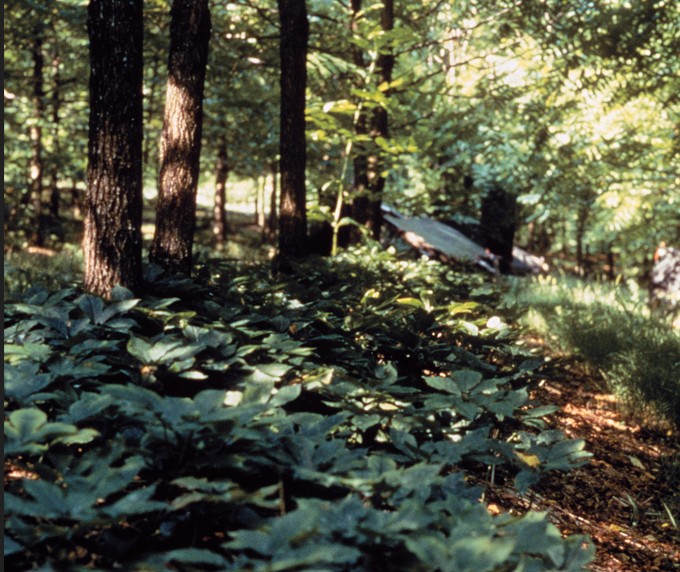
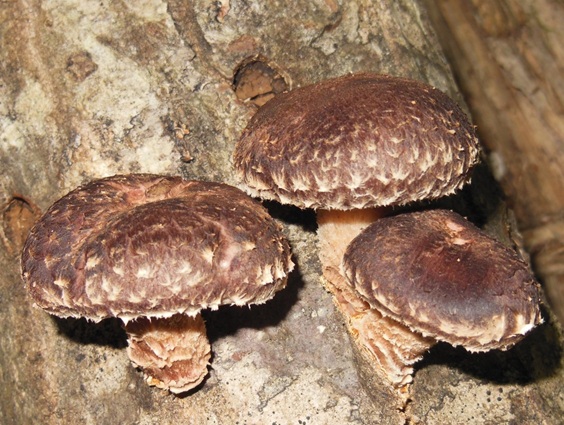
Forest farming combines aspects of forestry and small-scale farming through intentionally managing crops through multi-story cropping. Benefits of forest farming include increased diversity, improved habitat, and improved soil health1 2. Forest farming requires intentional management, including the use of vertical space, and provides an avenue to produce non-timber forest products. Common forest farming products can be sold for medicinal, culinary, or ornamental use. Depending on the goals of the producer, canopy shade levels can be adjusted through changes in species composition and forest structure. Forest farming can vary in management intensity, with three recognized methods of management: wood grown, wild-simulated, and managed wild populations.
Key aspects and considerations:
- Consider interactions between plants and microclimate.
- Choose trees with low to moderate root and crown spread.
- Select crops that are tolerant of shade.
- Ensure trees are planted or managed with enough spacing to allow light for understory canopy growth.
- Select sites that are suitable for desired crops.
- Ensure proper documentation when growing protected species.
- Determine appropriate density and understory structure.
- Consider slope aspect when determining where to plant.
- Forest farming maintains cultural traditions and recreational hobbies.
Benefits and Limitations
| ACRE Category | Benefits | Limitations |
|---|---|---|
| Soil Health |
|
|
| Water Management |
|
|
| Nutrient Management |
|
|
| Agricultural Production |
| |
| Biodiversity and Wildlife |
|
|
| GHG Emission |
|
|
| Economics |
|
|
Impact on Agricultural Resilience
- Forest farming modifies the microclimate for lower canopy plants, assisting with temperature regulation, humidity control, and water use efficiency, which makes the system more resilient to changing conditions7. Microclimate modification can be especially important under trends of increasing extreme heat and variable rainfall.
Regional Applicability
- Generally, forest farming is well suited for regions or states that already contain forested land. For example, forest farming may be well suited in Kentucky, as forestland is often maintained for wildlife habitat and recreation.
- Forest farming is not widely adopted in the region, though there are opportunities in parts of the Midwest, such as Wisconsin, where ginseng can grow under low light conditions. Additionally, depending on the management, maple syrup production can be a strong candidate for forest farming relevant to the Midwest region. Maple syrup production has grown steadily in the Midwest, increasing by over 200% from 2000 to 2013 in Ohio, Michigan, and Wisconsin10, making it a strong candidate for forest farming systems.
Case Studies
- At the Lawrence Community Orchard in Lawrence, Kansas, volunteers and community members plant and manage over 100 edible woody perennials, including fruit and nut trees. Skyler Adamson, the project coordinator, describes some of the justifications for forest farming: "Communities should be producing food, and perennials happen to be a lower-cost and lower-labor way to do that."
- In Wisconsin, Mark Shepard of New Forest Farm implements a range of agroforestry practices, including forest farming, where he produces chestnuts, hazelnuts, apples, asparagus, and pigs. Mark has spent decades increasing wildlife and improving organic matter on his farm, stating, "Agroforestry has the answers to so many challenges. We can solve them with programs we already have in place, and we can do it at a profit."
- In Amesville, OH, John Wood practices forest farming for maple syrup production. With 8 acres, John is able to sell directly to producers. John recommends learning from peers in your area if you're considering forest farming.
Resources
- Video. Savanna Institute: Everything You Wanted to Know about Forest Farming (but didn't know to ask)
- University of Wisconsin-Stevens Point Podcast: Forest Farming: Planting the Seed
- University of Missouri Center for Agroforestry: Forest Farming Agroforestry Training Manual
- University of Missouri Center for Agroforestry: Economic Budgeting for Agroforestry Practices
- USDA-NRCS: Agroforestry in Wisconsin
- USDA-NRCS: Small Scale Solution for Your Farm: Forest Farming
- Northcentral SARE: Forest Farming in Missouri: An Overview of the Production of Non-Timber Forest Products
- USDA-NRCS: Conservation Assessment and Planning Tools
- University of Nebraska Extension: Marketing Specialty Forest Products
- Rural Action: Forest Farming Budget Enterprise Scenario 1: Small Scale Production
- Rural Action: Forest Farming Budget Enterprise Scenario 2: Large Scale Production
- Lincoln University: Forest Farming Site Selection and Preparation Guidelines
- University of Missouri Center for Agroforestry: Growing Shiitake Mushrooms in an Agroforestry Practice
- National Center for Appropriate Technology: Community Forest Gardens: Case Studies Throughout the United States
- USDA-FS National Agroforestry Center: Forest Farming: An Agroforestry Practice
- USDA-FS National Agroforestry Center: Profitable Farms and Woodlands
- USDA-NRCS: Forest Farming (Ac.) (379) Conservation Practice Standard
References
- USDA-NRCS (2022). Conservation Practice Standard Document, Forest Farming, Code 379. https://www.nrcs.usda.gov/sites/default/files/2022-09/Forest_Farming_379_CPS_NHCP_2020.pdf
- USDA-NRCS (2022). Conservation Practice Standard Overview, Forest Farming, Code 379. https://www.nrcs.usda.gov/sites/default/files/2022-09/Forest_Farming_379_PO_2022.pdf
- University of Missouri--Columbia, Center for Agroforestry. (2024). Training Manual for Applied Agroforestry Practices. University of Missouri Center for Agroforestry.
- Chamberlain, J. L., Davis, J., & Munsell, J. F. (2021). Forest Farming Practices. North American Agroforestry, 281-313.
- Idassi, J. O. (2012). Profitable Farms and Woodlands: A Practical Guide in Agroforestry for Landowners, Farmers and Ranchers. Lincoln, Nebraska: USDA National Agroforestry Center.
- Lawrence, N., Ahamed, A., Conway, A., Covey, K., Chenyang, L., Machado, S., Wardropper, C., Stutzman, E., & Mize, C. (2025). Agroforestry and Climate Outcomes: Literature Review and Technical Guidance. Technical Advisory Network for Climate Smart Agricultural Practices. https://doi.org/10.5281/zenodo.15776654
- Schoeneberger, M. M., & Bentrup, G. (2017). Agroforestry: enhancing resiliency in US agricultural landscapes under changing conditions. Gen. Tech. Report WO-96. Washington, DC: US Department of Agriculture, Forest Service, 96.
- Frey, G. E., Chamberlain, J. L., & Jacobson, M. G. (2023). Producers, production, marketing, and sales of non-timber forest products in the United States: a review and synthesis. Agroforestry Systems, 97(3), 355-368.
- Valdivia, C., & Poulos, C. (2009). Factors affecting farm operators' interest in incorporating riparian buffers and forest farming practices in northeast and southeast Missouri. Agroforestry Systems, 75(1), 61-71. https://doi.org/10.1007/s10457-008-9129-2
- Chamberlain, J., Teets, A., & Kruger, S. (2018). Nontimber forest products in the United States: an analysis for the 2015 National Sustainable Forest Report. e-Gen. Tech. Rep. SRS-229, Asheville, NC: US Department of Agriculture, Forest Service, Southern Research Station, 229, 1-36. https://doi.org/10.2737/SRS-GTR-229