Wildlife Habitat Planting (NRCS #420)
Applicable Systems
About
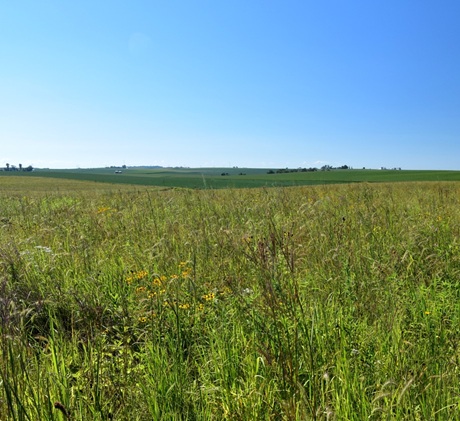
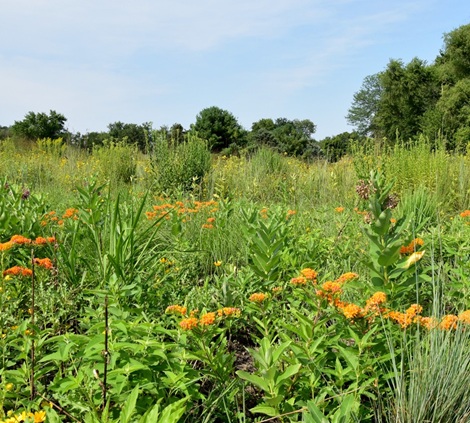
Wildlife Habitat Planting, or the improvement of degraded habitat, involves planting herbaceous vegetation or shrubs. Wildlife habitat plantings can increase species diversity, richness, structure or pattern1 2. Habitat plantings should be designed based on the historic, desired, and reference native plant community.
Key aspects and considerations:
- Plant noninvasive species.
- Use native plants when possible.
- Consider historical land cover when determining which species to plant.
- Consider adjacent land-use and habitats when establishing wildlife goals.
- For pollinator habitat, complete management and maintenance activities outside of the growing season or bloom period.
- Avoid using insecticides in pollinator habitats.
- When deciding where to plant, consider relationships with other habitat components, exposure, soils, and existing permanent cover.
Benefits and Limitations
| ACRE Category | Benefits | Limitations |
|---|---|---|
| Soil Health |
| |
| Water Management |
|
|
| Nutrient Management |
| |
| Agricultural Production |
|
|
| Biodiversity and Wildlife |
|
|
| GHG Emission | ||
| Economics |
|
|
Impact on Agricultural Resilience
- As habitat ranges shift in response to climate change, wildlife habitat plantings help wildlife adapt to these changes. Additionally, native species are more well suited for the landscape and are likely to be more resilient to extreme weather events.
Regional Applicability
- Wildlife habitat plantings are applicable to much of the cropland and forested areas across the Midwest. With over 127 million acres of agricultural land in the Midwest and expanding urbanization in parts of the region, ensuring adequate wildlife habitat is increasingly important.
Case Studies
- A large scale prairie planting in Michigan led by Doug Landis, a professor of Entomology at Michigan State University, incorporates native species with multiple goals in mind, including habitat creation and ecological restoration.
- Cathy Irvine of Dysart, Iowa converted 77 acres of her farm to prairie, creating wildlife habitat. Irvine partnered with the Tallgrass Prairie Center, and together they selected diverse plant species based on the topography and soil of the farm.
- In Mills County, Iowa, Jon Bakehouse farms Maple Edge Farm with his family. The farm has implemented multiple NRCS conservation practices to enhance wildlife, including pollinator plantings and prairie strips. Bakehouse describes his process: "I'm trying to get some of that mosaic reestablished, to get back to what made Iowa prairie so resilient."
Resources
- Xerces Society: Habitat Installation Guides
- Xerces Society: Habitat Installation Guide: Upper Midwest
- Iowa State University: Landscaping for Wildlife
- Iowa Department of Natural Resources: Wildlife Landowner Assistance
- USDA-NRCS: Iowa Native Prairie Planting Guide
- Illinois Extension: Native Plant Resources
- Illinois Extension: Wildlife Benefits of Native Shrubs (video)
- Indiana NRCS: Wildlife Management Practices
- USDA-NRCS: Working Lands for Wildlife
- USDA-NRCS: Conservation Enhancement Activity
- USDA-NRCS: Wildlife Habitat Planting (video)
References
- USDA-NRCS (2019). Conservation Practice Standard Document, Wildlife Habitat Planting, Code 420. https://www.nrcs.usda.gov/sites/default/files/2022-10/Wildlife_Habitat_Planting_420_NHCP_CPS_2018.pdf
- USDA-NRCS (2019). Conservation Practice Standard Overview, Wildlife Habitat Planting, Code 420. https://www.nrcs.usda.gov/sites/default/files/2022-10/Wildlife_Habitat_Planting_420_NHCP_PO_2018.pdf
- Holland, J. M., Douma, J. C., Crowley, L., James, L., Kor, L., Stevenson, D. R., & Smith, B. M. (2017). Semi-natural habitats support biological control, pollination and soil conservation in Europe: a review. Agronomy for Sustainable Development, 37(4), 31.
- Wratten, S. D., Gillespie, M., Decourtye, A., Mader, E., & Desneux, N. (2012). Pollinator habitat enhancement: benefits to other ecosystem services. Agriculture, Ecosystems & Environment, 159, 112-122.
- Lowe, E. B., Groves, R., & Gratton, C. (2021). Impacts of field-edge flower plantings on pollinator conservation and ecosystem service delivery -- A meta-analysis. Agriculture, Ecosystems & Environment, 310, 107290.
- Ellison, K. S., Ribic, C. A., Sample, D. W., Fawcett, M. J., & Dadisman, J. D. (2013). Impacts of tree rows on grassland birds and potential nest predators: a removal experiment. PLoS One, 8(4), e59151.
- Swan, A., Oldfield, E., & Toureene, C. (2025). Perennial Plantings and Climate Outcomes: Literature Review and Technical Guidance. Technical Advisory Network for Climate Smart Agricultural Practices. https://doi.org/10.5281/zenodo.15777153
- He, T., Ding, W., Cheng, X., Cai, Y., Zhang, Y., Xia, H., et al. (2024). Meta-analysis shows the impacts of ecological restoration on greenhouse gas emissions. Nature Communications, 15(1), 2668.
- Matamala, R., Jastrow, J. D., Miller, R. M., & Garten, C. T. (2008). Temporal changes in C and N stocks of restored prairie: implications for C sequestration strategies. Ecological Applications, 18(6), 1470-1488.