Grassed Waterways (NRCS #412)
Applicable Systems
About
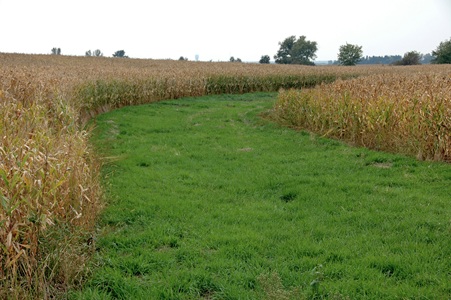
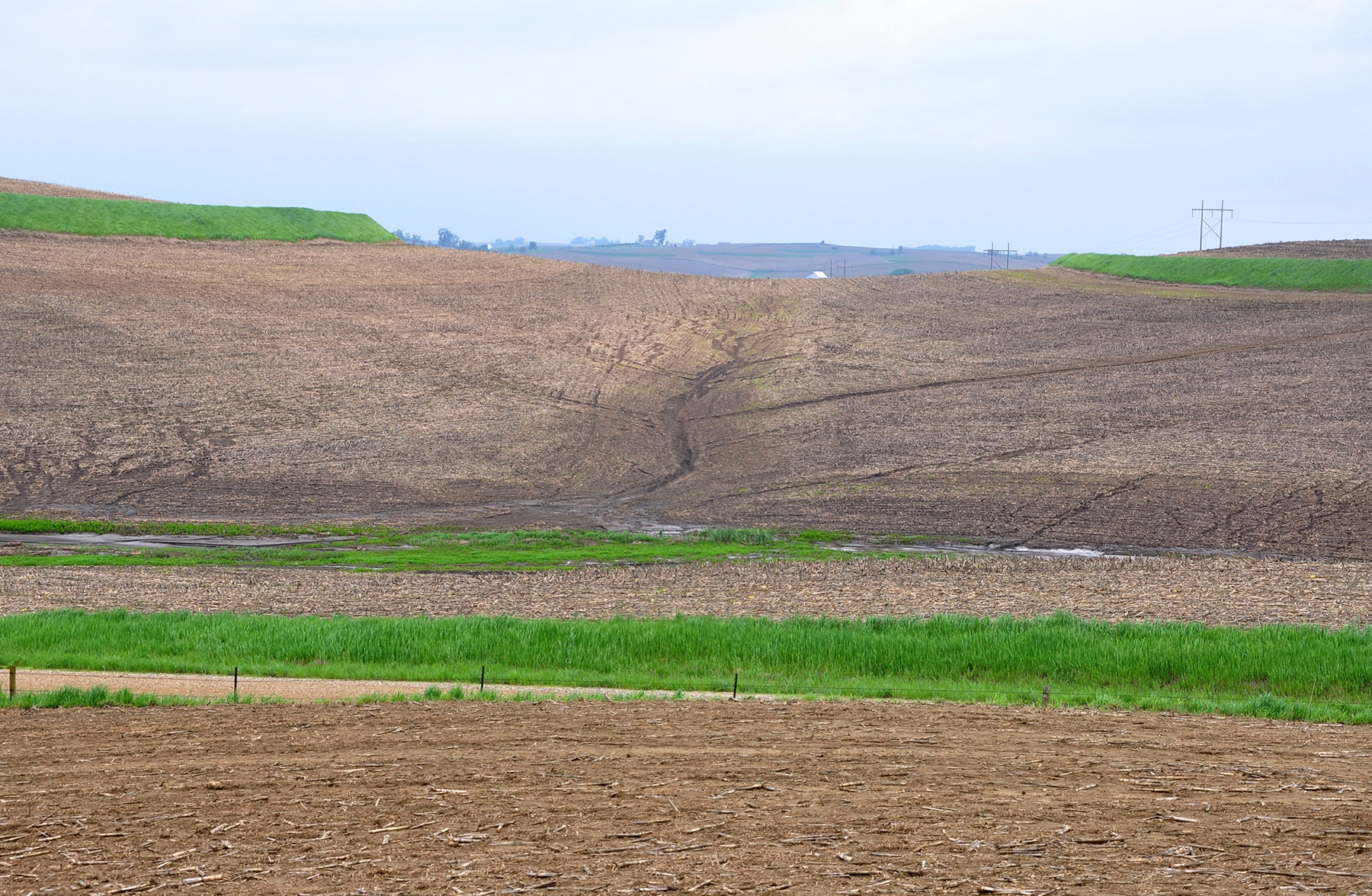
Grassed waterways1 are channels with vegetation used to convey water flows to prevent soil erosion, gully formation and flooding. They are also used to protect water bodies and water quality.
Key aspects and considerations:
- Consider federal, state, and local laws and regulations, species selection, topography, and common associated practices2.
- Establish grassed waterways where runoff from arable land concentrates.
- Select species able to achieve adequate density, height, and vigor within an appropriate time frame.
- Preserve waterway capacity, vegetative cover, and outlet stability through maintenance.
- Fill and reseed eroded areas quickly after heavy rainfalls to prevent further erosion.
- Allow livestock and vehicle crossings perpendicular to the waterway.
- Do not use grassed waterways as field roads.
- Evaluate costs based on site-specific characteristics such as slope, soil type, and drainage.
Benefits and Limitations
| ACRE Category | Benefits | Limitations |
|---|---|---|
| Soil Health |
|
|
| Water Management |
|
|
| Nutrient Management |
|
|
| Agricultural Production |
|
|
| Biodiversity and Wildlife |
|
|
| GHG Emission |
|
|
| Economics |
|
|
Impact on Agricultural Resilience
- Grassed waterways buffer extreme rainfall and flooding by slowing down runoff and increasing infiltration, making water available for plants in dry periods.
- Act as natural filters by intercepting contaminants (sediment, nutrients, pesticides, pathogens) before reaching streams, thus protecting soil and water quality.
Regional Applicability
- In Midwest corn-soybean systems, grassed waterways help to prevent erosion during bare soil periods.
- Discovery Farms has an ongoing edge-of-field monitoring site study in Kewaunee County, Wisconsin, which started in 2019 and illustrates the impact and importance of stable grassed waterways.
- In Iowa, mixes of brome-alfalfa are recommended for grassed waterways because they require low maintenance and have the ability to auto-repair when damaged by heavy storms. However, mow and weed control are required.
- According to Iowa Agriculture Water Alliance, "the cost of constructing a grassed waterway depends on the area draining to the waterway, the slope of your land, and the length of the waterway. If only seeding is needed, installation is estimated at around $30-$40 per acre. If you're looking to construct a waterway from scratch, it could cost around $2,000 per acre. Maintenance costs involve mowing and average $20 per acre annually."
Case Studies
- Get to know how Ray Gaesser, a farmer in Adams County, Iowa, combines no-tillage and grassed waterways to improve his cropland with healthy soil management. "Water infiltration tests show Ray's fields can absorb an inch of water in two to three seconds. Comparable fields with a history of tillage take seven to eight minutes to absorb that much water."
- Dan and Ruth Boerst, dairy farmers in Manawa, Wisconsin, installed grassed waterways through the Environmental Quality Incentives Program to improve water quality by trapping sediment and preventing sediment and nutrients from reaching the Little Wolf River. "We've always been involved in implementing conservation," said Dan.
- Conservation efforts, including grassed waterways, are being continually implemented by Jim and Melody Bourn in Southwest Iowa to ensure their land remains productive and sustainable for future generations.
Resources
- Video. USDA-NRCS: Grassed Waterway
- Video. Blanchard River Demonstration Farms Network: Grassed Waterways Conservation | Ohio Demo Farms
- Video. Iowa Farm Bureau: Grassed Waterways Protect Iowa Soil and Water
- Clean Water Iowa: Grassed Waterway
- Penn State Extension: Roadside Guide to Clean Water: Grassed Waterways
- USDA Natural Resources Conservation Service, Iowa Conservation Practice 412: Grassed Waterway Iowa Fact Sheet
References
- USDA-NRCS (2020). Conservation Practice Standard Document, Grassed Waterway, Code 412. https://www.nrcs.usda.gov/sites/default/files/2022-09/Grassed_Waterway_412_CPS_9_2020.pdf
- USDA-NRCS (2020). Conservation Practice Standard Overview, Grassed Waterway (Code 412). https://www.nrcs.usda.gov/sites/default/files/2022-09/Grassed_Waterway_412_Overview_9_2020.pdf
- Fiener, P. & Auerswald, K. (2003). Concept and effects of a multi-purpose grassed waterway. Soil Use and Management, 19, 65-72. https://doi.org/10.1111/j.1475-2743.2003.tb00281.x
- Arora, K., Mickelson, S. K., & Baker, J. L. (2003). Effectiveness of Vegetated Buffer Strips in Reducing Pesticide Transport in Simulated Runoff. Transactions of the American Society of Agricultural Engineers, 46(3), 635-644. https://doi.org/10.2134/jeq2008.0266
- Bryan, G. G., & Best, L. B. (1991). Bird Abundance and Species Richness in Grassed Waterways in Iowa Row Crop Fields. The American Midland Naturalist, 126(1), 90-102. https://doi.org/10.2307/2426153
- Dermisis, D., Abaci, O., Papanicolaou, A. N., & Wilson, C. G. (2010). Evaluating grassed waterway efficiency in southeastern Iowa using WEPP. Soil Use and Management, 26, 183-192. https://doi.org/10.1111/j.1475-2743.2010.00257.x
- Glover, J. D., Cox, C. M., & Reganold, J. P. (2007). Future Farming: A Return to Roots? Scientific American, 83-89. https://landinstitute.org/wp-content/uploads/2007/08/Glover-et-al-2007-Sci-Am.pdf
- Miller, T. P., Peterson, J. R., Lenhart, C. F., & Nomura, Y. (2012). The Agricultural BMP Handbook for Minnesota. Minnesota Department of Agriculture, pp.84-86. https://www.house.mn.gov/comm/docs/AG-BMPHandbookforMN_09_2012.pdf