Alley Cropping (NRCS #311)
Applicable Systems
About
Alley Cropping (also known as hedgerow intercropping) is an agroforestry practice in which trees or shrubs are planted in linear rows, with alleyways planted with forage or crops. By integrating both annual and perennial crops on the same piece of land, growers can harvest annual crops while waiting on trees or shrubs to mature. Alley cropping benefits include enhanced microclimate, reduced runoff, improved soil health, increased diversity, and increased carbon storage1 2. In addition to promoting plant productivity and reducing soil erosion, alley cropping also allows for flexibility and diversity in the types of crops grown. For instance, the tree or shrub species used in alley cropping systems may include species used for timber, nut production, fruit production, or other woody specialty crops. Through the integration of perennials, alley cropping offers tools for both climate adaptation and mitigation, but also requires a long-term perspective.
Key aspects and considerations:
- When designing an alley cropping system, consider: site characteristics, species selection and interactions, spacing between rows and alleys to avoid competition and allow machinery access, equipment and labor availability, timing of crop harvests, tree-row orientation, and resource requirements of each crop.
- Integrate management of multi-species systems.
- Manage shading to avoid yield loss.
- Choose companion species to reduce unwanted competition and pests.
Benefits and Limitations
| ACRE Category | Benefits | Limitations |
|---|---|---|
| Soil Health |
|
|
| Water Management |
|
|
| Nutrient Management |
|
|
| Agricultural Production |
|
|
| Biodiversity and Wildlife |
|
|
| GHG Emission |
| |
| Economics |
|
|
Impact on Agricultural Resilience
- Looking forward, the Midwest is projected to experience an increase in the number of days above 90 degrees (F) and an increase in the frequency of heavy rainfall events12. Through improved water, soil, and nutrient regulation, alley cropping systems are more resilient to extreme rainfall events. Alley cropping can modify the microclimate, including reducing light intensity, wind speed, and surface water runoff4 13. These modifications buffer the impacts of extreme weather and promote crop resilience.
Regional Applicability
- Though not widely adopted14, alley cropping is applicable across the Midwest and can be implemented with a variety of crops. In the Midwest, common alley cropping systems include wheat, corn, soybeans, or hay planted alongside black walnut or pecan. Demonstration farms in Wisconsin and Illinois serve as examples of alley cropping in progress. In areas where tile or subsurface drainage is prevalent, distance to tile lines should be considered, as tree roots can clog tile drainage lines.
Case Studies
- Meet Sarah Barney, owner and operator of Among the Oaks Herb Farm in Kentucky, and Badger Johnson of Southern Ohio Chestnut Company Home Farm. Sarah has 1 acre of total production and half an acre alley cropped. Badger converted 1.25 acres of cattle to a chestnut orchard in an alley cropping system.
- At Red Fern Farm in Iowa, Kathy Dice and Tom Wahl have been farming the land since the early 1990s. They currently practice a mix of alley cropping and silvopasture, and their products include chestnuts, pawpaws, apples, and sheep -- they've experienced a growing demand for chestnut seeds and seedlings and have witnessed an increase in soil organic matter over the decades.
- At Big River Chestnuts, a 7.5-acre farm in Massachusetts, Jono Neiger describes his decision to plant trees: "Trees are more resilient... fundamentally, these perennial crops, trees and shrubs, they have a natural buffering effect on the land. So, if you have a drought, they are rooting deeply; you have a flood, they're not going to get washed away, generally, they're going to capture and hold water."
- In year eight, Big River Chestnuts is still repaying their initial start-up costs. But they are also being met with excitement and demand from the community. "We sell out - it's actually good food, too... There's a solid market, and there's excitement about the way we're producing," says Jono Neiger, Farmer/Owner.
- In Snohomish, Washington, Nick Pate integrated rows of apple trees into his hay fields, creating an alley cropping system. Planting cider apple trees has allowed Nick to diversify his income while promoting ecological benefits and increasing resilience across his farm. Nick has observed that the hay planted in his alley cropping system is more resilient to hot and dry conditions, staying greener longer than hay planted in open fields.
Resources
- Video. USDA-NRCS: NRCS Practice 311 - Alley Cropping
- Savanna Institute: Understanding Agroforestry: Alley Cropping
- Savanna Institute: Agroforestry Resource Library
- Savanna Institute Perennial AF Podcast: Illinois Agroforestry Farm Tour with Kaitie Adams
- Video. Savanna Institute: Alley Cropping -- 5 Agroforestry Practices Explained
- Savanna Institute: Technical Assistance Program
- Carbon180: Agroforestry Case Studies - Champions of Agroforestry in the Upper Midwest
- Pasa Sustainable Agriculture: Alley Cropping at Many Streams Farm Case Study
- Association for Temperate Agroforestry: Alley Cropping Article Library
- Association for Temperate Agroforestry: Agroforestry in Central Wisconsin: A Demonstration Project
- University of Missouri Center for Agroforestry: Alley Cropping Training Manual
- USDA National Agroforestry Center, Agroforestry Notes: Alley Cropping: An Agroforestry Practice
- University of Maryland: What to Know About Alley Cropping
- The Illinois Nutrient Loss Reduction Podcast: Episode 73, Branching Out: Agroforestry's Role in Reducing Nutrient Loss
- USDA National Agroforestry Center: Alley Cropping
- USDA National Agroforestry Center: Alley Cropping album
- Croatan Institute and Savanna Institute: Financing Trees & Perennial Crops for Your Farm: An Agroforestry Primer
- USDA-NRCS: Conservation Planning Tools
- USDA-NRCS: Small Scale Solutions for your Farm
References
- USDA-NRCS (2017). Conservation Practice Standard Document, Alley Cropping, Code 311. https://www.nrcs.usda.gov/sites/default/files/2022-08/Alley_Cropping_311_CPS_Oct_2017.pdf
- USDA-NRCS (2017). Conservation Practice Standard Overview, Alley Cropping, Code 311. https://www.nrcs.usda.gov/sites/default/files/2022-08/Alley_Cropping_311_Overview_Oct_2017.pdf
- Beule, L., Vaupel, A., & Moran-Rodas, V. E. (2022). Abundance, diversity, and function of soil microorganisms in temperate alley-cropping agroforestry systems: a review. Microorganisms, 10(3), 616.
- Garrett, H. E. G., Wolz, K. J., Walter, W. D., Godsey, L. D., & McGraw, R. L. (2021). Alley cropping practices. North American Agroforestry, 163-204. https://doi.org/10.1002/9780891183785.ch7
- Mayer, S., Wiesmeier, M., Sakamoto, E., Hübner, R., Cardinael, R., Kühnel, A., & Kögel-Knabner, I. (2022). Soil organic carbon sequestration in temperate agroforestry systems -- A meta-analysis. Agriculture, Ecosystems & Environment, 323, 107689.
- Udawatta, R. P., Kremer, R. J., Nelson, K. A., Jose, S., & Bardhan, S. (2014). Soil quality of a mature alley cropping agroforestry system in temperate North America. Communications in Soil Science and Plant Analysis, 45(19), 2539--2551. https://doi.org/10.1080/00103624.2014.932376
- Jacobs, S. R., Webber, H., Niether, W., Grahmann, K., Lüttschwager, D., Schwartz, C., et al., & Bellingrath-Kimura, S. D. (2022). Modification of the microclimate and water balance through the integration of trees into temperate cropping systems. Agricultural and Forest Meteorology, 323, 109065. https://doi.org/10.1016/j.agrformet.2022.109065
- Veldkamp, E., Schmidt, M., Markwitz, C., Beule, L., Beuschel, R., Biertümpfel, A., et al., & Corre, M. D. (2023). Multifunctionality of temperate alley-cropping agroforestry outperforms open cropland and grassland. Communications Earth & Environment, 4(1), 20.
- Lawrence, N., Ahamed, A., Conway, A., Covey, K., Chenyang, L., Machado, S., Wardropper, C., Stutzman, E., & Mize, C. (2025). Agroforestry and Climate Outcomes: Literature Review and Technical Guidance. Technical Advisory Network for Climate Smart Agricultural Practices. https://doi.org/10.5281/zenodo.15776654
- Gamble, J. D., Johnson, G. A., Current, D. A., Wyse, D. L., Zamora, D. S., & Sheaffer, C. C. (2020). Alley cropping affects perennial bioenergy crop root distribution, carbon, and nutrient stocks. Agronomy Journal, 112(5), 3718-3732.
- Tsonkova, P., Böhm, C., Quinkenstein, A., & Freese, D. (2012). Ecological benefits provided by alley cropping systems for production of woody biomass in the temperate region: a review. Agroforestry Systems, 85, 133-152. https://doi.org/10.1007/s10457-012-9494-8
- Wuebbles, D. J., & Hayhoe, K. (2004). Climate change projections for the United States Midwest. Mitigation and Adaptation Strategies for Global Change, 9(4), 335-363.
- Schoeneberger, M. M., & Bentrup, G. (2017). Agroforestry: enhancing resiliency in US agricultural landscapes under changing conditions. Gen. Tech. Report WO-96. Washington, DC: US Department of Agriculture, Forest Service, 96.
- Smith, M. M., Bentrup, G., Kellerman, T., MacFarland, K., Straight, R., & Ameyaw, L. (2022). Agroforestry extent in the United States: A review of national datasets and inventory efforts. Agriculture, 12(5), 726.
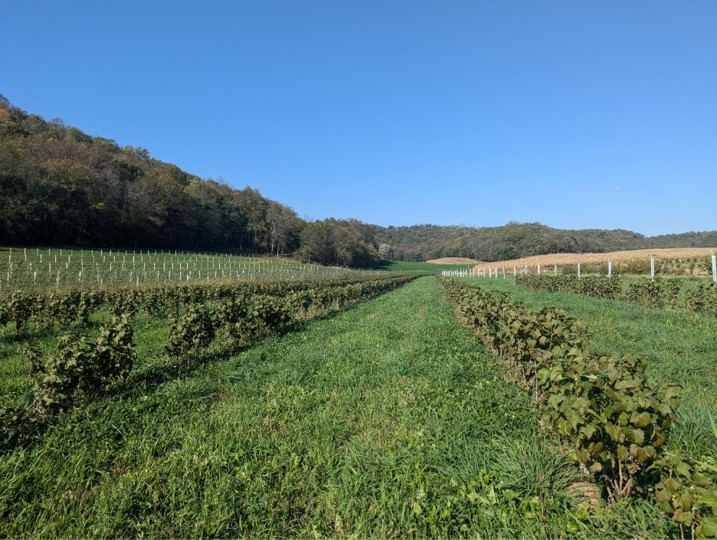
Photo 1: The Savanna Institute's experimental farm in Wisconsin provides multiple demonstrations of recently established alley cropping systems.
Photo provided by Tracy Campbell.
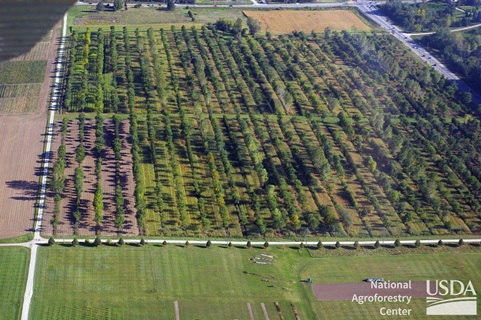
Photo 2: Aerial image of an alley cropping research plot in Guelph, Canada. Rows of trees are spaced to allow for crop production within alleys.
Photo provided by the USDA National Agroforestry Naresh Tevathasan.