Conservation Cover (NRCS #327)
Applicable Systems
About
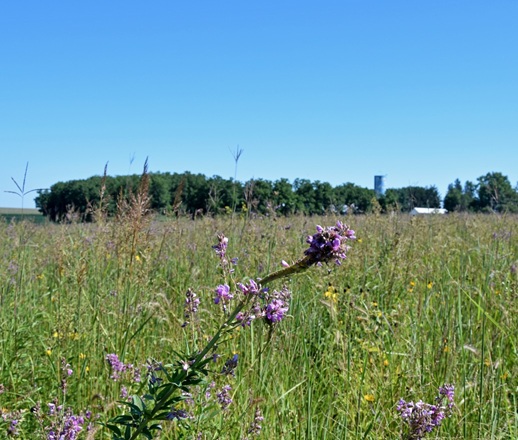
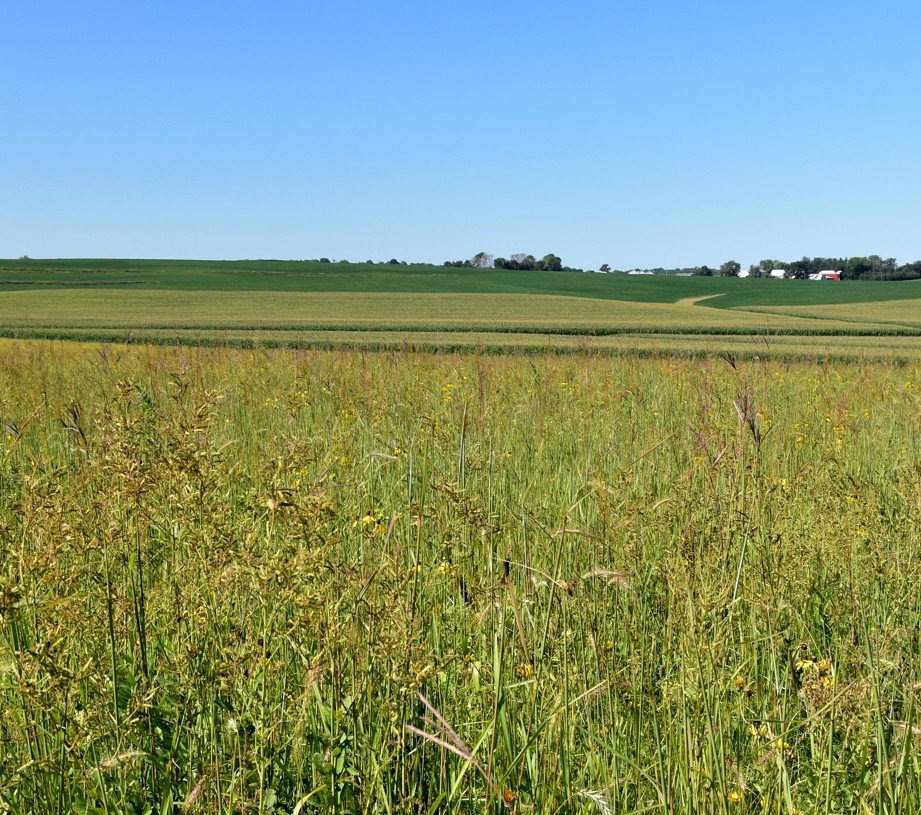
Conservation cover refers to the practice of establishing permanent vegetative cover on the land, and is sometimes referred to as a permanent cover crop. Conservation cover offers a strategy to reduce soil erosion, improve water quality, increase soil quality, and enhance wildlife and pollinator habitat1 2. Examples of conservation cover include prairie plantings, grass buffers, or a mix of grass, trees, and shrubs planted in permanent strips along crop fields. Grassed alleyways in orchards or vineyards also are an example of conservation cover. Generally, cost of establishment and maintenance vary depending on species selection, maintenance, and management requirements.
Key aspects and considerations:
- Choose species that are adapted for climate and site characteristics.
- Ensure the site is properly prepared for planting conservation cover.
- Select species that reflect management practices, goals, and objectives.
- Consider planting milkweed or other native grasses and flowers to further improve wildlife and pollinator habitat.
- Remember, conservation cover is not intended for forage production.
Benefits and Limitations
| ACRE Category | Benefits | Limitations |
|---|---|---|
| Soil Health |
| |
| Water Management |
|
|
| Nutrient Management |
|
|
| Agricultural Production |
|
|
| Biodiversity and Wildlife |
|
|
| GHG Emission |
| |
| Economics |
|
|
Impact on Agricultural Resilience
- Improved infiltration can help mitigate the impacts of extreme rainfall, and deep-rooted perennials are more resilient to drought due to improved water uptake.
- Native plant communities are often more resilient to disturbances than conventional cover crops.
Regional Applicability
- Conservation cover is widely applicable to the Midwest and can take on a variety of different forms depending on producer goals, cropping system, and site factors. The Iowa State Prairie STRIPS project is an example of conservation cover, in which prairie strips are integrated into row-crop agriculture, and has been established in 14 states across the U.S., many based in the Midwest.
Case Studies
- In southeast Indiana, Bob and Ellen Mulford transformed their farm into wildlife habitat with a variety of CRP projects, including establishing permanent vegetative cover. Bob describes some of the changes they've witnessed on the farm, stating, "We have documented over 200 species of birds. We see reptiles, amphibians and mammals of every kind..."
- In Merced, CA, Ralf Sauter and his family grow almonds on 116 orchard acres. They implement a range of soil health practices, including conservation cover. Ralf and his family use native vegetation as cover over the winter, which has promoted beneficial insects and helped with mite control. Including all of his conservation practices, Ralf has seen a 198% return on investment. "I do all these soil health practices for their economic benefit. A lot of people talk about 'sustainable farming.' What is that? For me, it's being profitable each year with healthier trees and healthier soils," says Ralf Sauter.
Resources
- Iowa NRCS: Conservation Cover
- Video. USDA-NRCS: Conservation Cover
- Sustainable Agriculture Research and Education (SARE): Conservation Cover Informational Packet
- Iowa State University: Prairie STRIPS establishment and management
- University of Wisconsin Extension: Orchard Floor Management for Fruit Trees
- California Farm Bureau: Quick Guide Conservation Cover
- Xerces Society: Habitat Installation Guides
References
- USDA-NRCS (2024). Conservation Practice Standard Document, Conservation Cover, Code 327. https://www.nrcs.usda.gov/sites/default/files/2024-06/327-nhcp-cps-conservation-cover-2024.pdf
- USDA-NRCS (2014). Conservation Practice Overview, Conservation Cover, Code 327. https://www.nrcs.usda.gov/sites/default/files/2022-09/Conservation_Cover_327_Overview.pdf
- Stephenson, J. A., Liebman, M., Niemi, J., Cruse, R., Tyndall, J., Witte, C., et al., & Helmers, M. (2024). The influence of prairie strips sown in midwestern corn and soybean fields on sediment discharge throughout the year. Journal of Soil and Water Conservation, 79(2), 87-98.
- Wick, A., Berti, M., Lawley, Y., & Liebig, M. (2017). Integration of annual and perennial cover crops for improving soil health. In Soil Health and Intensification of Agroecosystems (pp. 127-150). Academic Press.
- Matamala, R., Jastrow, J. D., Miller, R. M., & Garten, C. T. (2008). Temporal changes in C and N stocks of restored prairie: implications for C sequestration strategies. Ecological Applications, 18(6), 1470-1488. https://doi.org/10.1890/07-1609.1
- Kemmerling, L. R., McCarthy, A. C., Brown, C. S., & Haddad, N. M. (2023). Butterfly biodiversity increases with prairie strips and conservation management in row crop agriculture. Insect Conservation and Diversity, 16(6), 828-837.
- Swan, A., Oldfield, E., & Toureene, C. (2025). Perennial Plantings and Climate Outcomes: Literature Review and Technical Guidance. Technical Advisory Network for Climate Smart Agricultural Practices. https://doi.org/10.5281/zenodo.15777153
- He, T., Ding, W., Cheng, X., Cai, Y., Zhang, Y., Xia, H., et al., & Zhang, Q. (2024). Meta-analysis shows the impacts of ecological restoration on greenhouse gas emissions. Nature Communications, 15(1), 2668.