Composting Facility (NRCS #317)
Applicable Systems
About
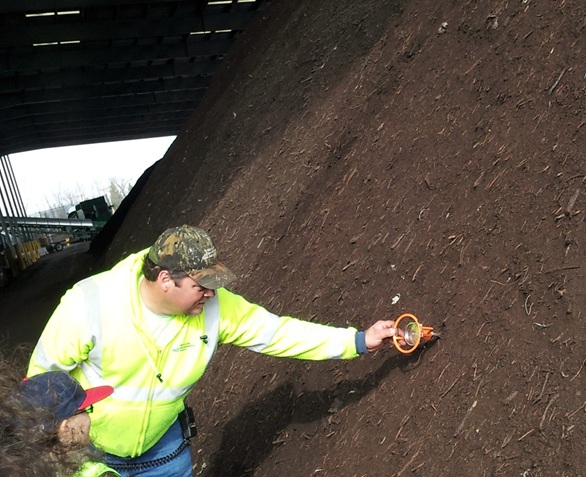
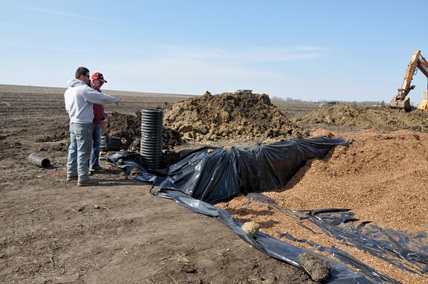
Composting facility1 is a facility or device to contain and facilitate controlled aerobic decomposition of organic waste derived from agriculture or processing, and conversion into stabilized soil amendment and horticultural media.
Key aspects and considerations:
- Does not apply to poultry carcasses, and routine storage and handling of animal manure solids.
- Requires a site-specific plan in accordance with local, state, and federal laws and regulations.
- Requires a consistent supply of feedstocks and proper C:N balance.
- Requires compost stability to enhance environmental benefits and minimize tradeoffs2.
- Requires management of some metals to avoid soil contamination and phytotoxicity2.
- Provides an appropriate and productive use for agricultural and processing wastes.
- Requires regular monitoring of moisture, temperature, aeration, and C:N ratio.
Benefits and Limitations
| ACRE Category | Benefits | Limitations |
|---|---|---|
| Soil Health |
|
|
| Water Management |
|
|
| Nutrient Management |
|
|
| Agricultural Production |
|
|
| Biodiversity and Wildlife |
|
|
| GHG Emission |
|
|
| Economics |
|
|
Impact on Agricultural Resilience
- Increases soil resilience to drought and extreme weather.
- Helps to mitigate the effects of droughts because soil holds more water for longer.
Regional Applicability
- CompostNow in Raleigh, North Carolina, collects food and organic wastes from residential, commercial, and industrial businesses and transforms them into composts for landscapes and agriculture.
- Iowa State University Compost Facility was constructed in 2008 for composting organic waste materials from several campus sources. The facility is designed to handle more than 10,000 tons of organic waste annually.
Resources
- Video. USDA-NRCS: Composting Facility
- Video. Phoenix Public Works Department: Compost Facility Tour
- Iowa Department of Natural Resources (2020): Composting for Iowa Communities
- US Environmental Protection Agency: Composting at Home
- Wisconsin Department of Natural Resources (DNR): Composting in Wisconsin
- USDA NRCS: Part 637 Environmental Engineering National Engineering Handbook. Chapter 2 -- Composting
- Test Method for the Examination of Composting and Compost (TMECC): Provides detailed protocols for the composting industry to verify the physical, chemical, and biological condition of composting feedstocks, material in process, and compost products at the point of sale.
References
- USDA-NRCS (2020). Conservation Practice Standard Document, Composting Facility, Code 317. https://www.nrcs.usda.gov/sites/default/files/2022-09/Composting_Facility_317_CPS_9_2020.pdf
- Barrena, R., Font, X., Gabarrell, X., & Sánchez, A. (2014). Home composting versus industrial composting: Influence of composting system on compost quality with focus on compost stability. Waste Management, 34(7), 1109-1116. https://doi.org/10.1016/j.wasman.2014.02.008
- Thomson, A., Price, G. W., Arnold, P., Dixon, M., & Graham, T. (2022). Review of the potential for recycling CO2 from organic waste composting into plant production under controlled environment agriculture. Journal of Cleaner Production, 333, 130051. https://doi.org/10.1016/j.jclepro.2021.130051