Windbreaks (NRCS #380)
Applicable Systems
About
Windbreaks, also referred to as shelterbelts, are an edge of field practice and function to protect crops, livestock, and buildings from wind through the linear planting of trees. Across the globe, windbreaks have been planted for centuries to protect agricultural land. In the United States, in response to the 1930s Dust Bowl, over 96,000 hectares of windbreaks were planted across the Great Plains to prevent further soil loss and wind erosion. Today, windbreaks are one of the five agroforestry practices recognized by the USDA as a conservation strategy. Windbreaks protect crops, soil and livestock, and can be classified as field, livestock, or farm windbreaks. While the primary objective of windbreaks is to reduce wind speed, numerous ecosystem benefits are offered if designed and managed appropriately1 2.
Key aspects and considerations:
- Plant trees or shrubs in single or multiple linear rows.
- Plant trees or shrubs perpendicular to the direction of wind.
- Choose species that are adapted to site and climate conditions.
- Perform regular maintenance in the early stages of establishment.
- Consider windbreak structure (spacing, height, species, length, and orientation) and management goals: tree height influences the amount of area protected, and windbreaks reduce windspeed on the downwind side over a distance of 10-30 times tree height5.
- Consider windbreak density.
Benefits and Limitations
| ACRE Category | Benefits | Limitations |
|---|---|---|
| Soil Health |
|
|
| Water Management |
| |
| Nutrient Management |
|
|
| Agricultural Production |
|
|
| Biodiversity and Wildlife |
|
|
| GHG Emission |
| |
| Economics |
|
|
Impact on Agricultural Resilience
- Windbreaks offer a strategy to reduce risks associated with a changing climate. Windbreaks can mitigate the impact of drought, heatwaves, and extreme wind on crops by improving water-use-efficiency, modifying the microclimate, and creating a zone of protection for crops14.
Regional Applicability
- Windbreaks are especially crucial in areas vulnerable to soil loss due to the presence of strong wind or coarse texture soils, and as a result, are extremely applicable to areas across the Midwest and Great Plains. Of the five agroforestry practices, windbreaks are the most widely planted according to recent work from the National Agroforestry Center, with most farms concentrated in the Northern Plains and Midwest regions8. Recent research identifies much of the Midwest, including central Illinois to northern Nebraska and north central Iowa as high environmental priority areas for windbreak adoption15. While past research has found that windbreaks can provide a net positive economic return, agroforestry adoption rates remain low.
Case Studies
- Frank and Jaci Mills of Mills Farm located in Crawford, Nebraska grew trees into a solid windbreak, several rows thick, helping protect their home and livestock from the wind and snow, and providing habitat for wildlife. Jaci describes some of the benefits: "The trees help spread the snow across the field more evenly, meaning moisture is spread across the field. Plus, it helps protect our home and buildings from the bitter wind."
- Mark Shepard, a Wisconsin farmer implementing both windbreaks and alley cropping, reflects, "Agroforestry has the answers to so many challenges. We can solve them with programs we already have in place, and we can do it at a profit."
- At Hudson Farms, in Urbana, IL, Kaitie Adams along with the Savanna Institute plant windbreaks to protect crops from wind damage and pesticide drift.
Resources
- Video. University of Illinois Extension Horticulture: Windbreaks: the History, Function, and Benefits of Diminished Wind Speeds
- Video. Savanna Institute: Windbreaks - 5 Agroforestry Practices Explained
- Podcast. Savanna Institute: The Pros and Cons of Windbreaks and Riparian Buffers
- Iowa State University Extension and Outreach: Windbreaks
- Iowa State University Extension and Outreach: Windbreaks for Wildlife
- University of Missouri Center for Agroforestry: Windbreaks Training Manual
- Iowa State University Extension and Outreach: Care and How-Tos: Windbreaks for Iowa
- University of Minnesota Extension: Selecting Trees and Shrubs for Windbreaks
- University of Nebraska-Lincoln Extension: Windbreaks for Livestock Operations
- University of Nebraska: Prairie States Forestry Project Digital Archive
- University of Wisconsin-Madison, Center for Integrated Agricultural Systems (CIAS): Windbreaks: Trees as Technology for Protecting Wisconsin's Topsoil (Research Brief #22)
- University of Wisconsin-Madison Division of Extension: Windbreaks - Agroforestry for Any Property
- USDA-FS National Agroforestry Center. Agroforestry Notes #25: Windbreaks: An Agroforestry Practice
- USDA-NRCS: Windbreak/Shelterbelt Establishment and Renovation (Ft.) (380) Conservation Practice Standard
References
- USDA-NRCS (2021). Conservation Practice Standard Document, Windbreak-Shelterbelt Establishment and Renovation, Code 380. https://www.nrcs.usda.gov/sites/default/files/2022-10/Windbreak-Shelterbelt_Establishment_380_NHCP_CPS_2021.pdf
- USDA-NRCS (2012). Conservation Practice Overview, Windbreak-Shelterbelt Establishment (Code 380) or Renovation (Code 650). https://www.nrcs.usda.gov/sites/default/files/2022-10/Windbreak-Shelterbelt_Establishment_380_PO.pdf
- Nordstrom, K. F., & Hotta, S. (2004). Wind erosion from cropland in the USA: a review of problems, solutions and prospects. Geoderma, 121(3-4), 157-167.
- Brandle, J. R., Hodges, L., & Zhou, X. H. (2004). Windbreaks in North American agricultural systems. In New Vistas in Agroforestry: A Compendium for 1st World Congress of Agroforestry, 2004 (pp. 65-78). Springer Netherlands. https://doi.org/10.1007/978-94-017-2424-1_5
- Brandle, J.R., Hodges, L., Tyndall, J. and Sudmeyer, R.A. (2009). Windbreak Practices. In North American Agroforestry: An Integrated Science and Practice, H.E. "Gene" Garrett (Ed.). https://doi.org/10.2134/2009.northamericanagroforestry.2ed.c5
- Vico, G., & Brunsell, N. A. (2018). Tradeoffs between water requirements and yield stability in annual vs. perennial crops. Advances in Water Resources, 112, 189-202.
- Weninger, T., Scheper, S., Lackóová, L., et al. (2021). Ecosystem services of tree windbreaks in rural landscapes -- a systematic review. Environmental Research Letters, 16(10), 103002. https://doi.org/10.1088/1748-9326/ac1d0d
- Smith, M. M., Floress, K., Kellerman, T., Bentrup, G., MacFarland, K., Batcheler, M., & Ameyaw, L. (2026). Windbreaks in the United States: results from the National Agroforestry Producer Survey. Agroforestry Systems, 100(5), 112.
- Smith, M. M., Bentrup, G., Kellerman, T., MacFarland, K., Straight, R., & Ameyaw, L. (2021). Windbreaks in the United States: A systematic review of producer-reported benefits, challenges, management activities and drivers of adoption. Agricultural Systems, 187, 103032. https://doi.org/10.1016/j.agsy.2020.103032
- Lawrence, N., Ahamed, A., Conway, A., Covey, K., Chenyang, L., Machado, S., Wardropper, C., Stutzman, E., & Mize, C. (2025). Agroforestry and Climate Outcomes: Literature Review and Technical Guidance. Technical Advisory Network for Climate Smart Agricultural Practices. https://doi.org/10.5281/zenodo.15776654
- Ballesteros-Possu, W., Brandle, J. R., & Schoeneberger, M. (2017). Potential of windbreak trees to reduce carbon emissions by agricultural operations in the US. Forests, 8(5), 138.
- Brandle, J. R., Johnson, B. B., & Akeson, T. (1992). Field windbreaks: are they economical? Journal of Production Agriculture, 5(3), 393-398.
- Osorio, R. J., Barden, C. J., & Ciampitti, I. A. (2019). GIS approach to estimate windbreak crop yield effects in Kansas-Nebraska. Agroforestry Systems, 93(4), 1567-1576.
- Schoeneberger, M. M., & Bentrup, G. (2017). Agroforestry: enhancing resiliency in US agricultural landscapes under changing conditions. Gen. Tech. Report WO-96. Washington, DC: US Department of Agriculture, Forest Service, 96. https://doi.org/10.2737/WO-GTR-96
- Castle, S. E., Miller, D. C., & Wardropper, C. B. (2025). Mapping the social-ecological suitability of agroforestry in the US Midwest. Environmental Research Letters, 20(2), 024041.
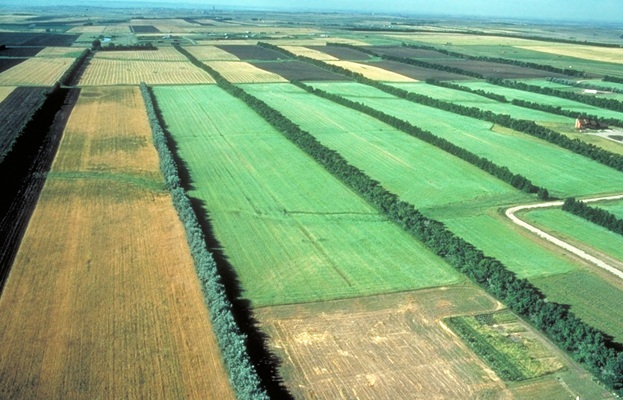
Photo 1: Windbreaks established surrounding crop fields reduce wind speed and protect fields from wind erosion.
Photo provided by the USDA National Agroforestry Center, taken by Garry Wells, USDA-NRCS.
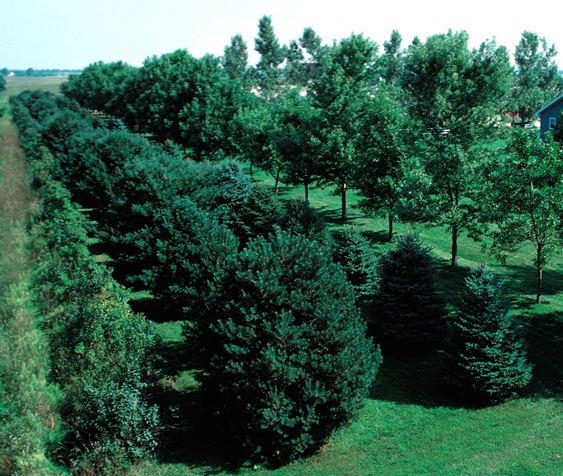
Photo 2: In northwestern Iowa, a multirow windbreak integrates shrubs, conifers, and deciduous trees to protect a farmstead.
Photo by Jason Johnson, Iowa NRCS.