Field Border (NRCS #386)
Applicable Systems
About
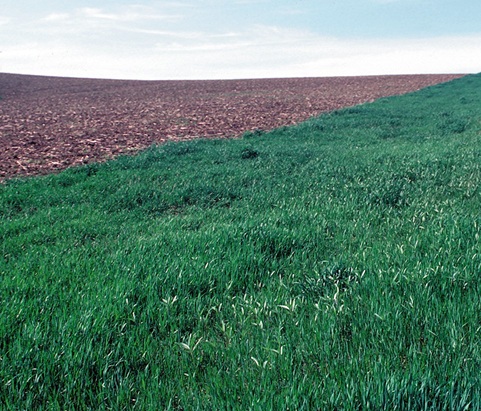
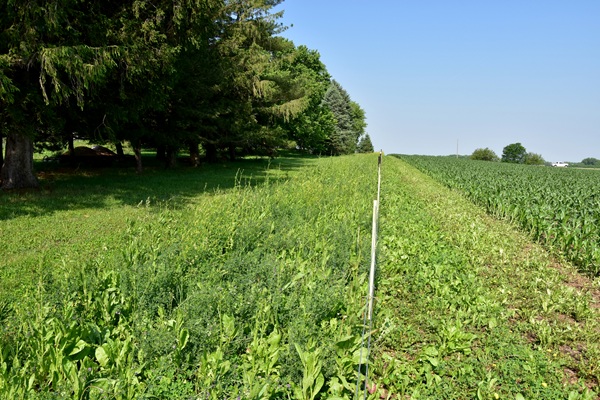
Field borders1 consist of strips of permanent vegetation, including grasses, forbs, legumes, or shrubs, that are established around the inside perimeter of a field. They can connect other buffers such as grassed waterways, filter strips, and contour buffer strips within and between fields.
Key aspects and considerations:
- Avoid vehicle traffic, or choose resistant species if the border will be used for equipment traffic.
- Select plants that create a dense cover to control wind and water erosion, and meet food, nesting and cover needs for wildlife.
- Orient plant rows perpendicularly to sheet flow direction to prevent erosion.
- Avoid exposing the field border to pesticides and other chemicals.
- Do not burn vegetation nor disturb the roots with tillage.
Benefits and Limitations
| ACRE Category | Benefits | Limitations |
|---|---|---|
| Soil Health |
|
|
| Water Management |
|
|
| Nutrient Management |
|
|
| Agricultural Production |
|
|
| Biodiversity and Wildlife |
|
|
| GHG Emission |
|
|
| Economics |
|
|
Impact on Agricultural Resilience
- Water is maintained in the productive system and crops are more resilient to drought conditions.
- Provides microclimate regulation by buffering extreme temperatures and wind reduction.
- Wildlife travel corridors allow species to move safely between habitats in response to climatic conditions.
Regional Applicability
- In Clay and Lowndes counties, Mississippi, experimental field borders were established along agricultural field margins, with an average of 6% of row crop field area converted to field border habitats, to measure summer and winter abundance and diversity of grassland birds relative to field border management practices.
- Semi-natural habitats like field borders may act as a source for many natural enemies. In central Illinois, five privately owned USDA certified organic fields with adjacent semi-natural field borders were examined and found to reduce agricultural impacts on the environment and enhance biodiversity and ecosystem services4.
Resources
- Video: The USDA NRCS Field Borders
- Video: Field Border Installation: How and Why It Works
- Video: How to Edit an Already Created Field Border
- University of Missouri Extension. Publication No. G9421: Field Borders for Agronomic, Economic and Wildlife Benefits
- University of Missouri Extension: Field Borders Benefit Wildlife on the Farm
- USDA Conservation Enhancement Activity: Enhanced Field Borders to Reduce Soil Erosion Along the Edge(s) of a Field
References
- USDA-NRCS (2016). Conservation Practice Standard Document, Field Border, Code 386. https://www.nrcs.usda.gov/sites/default/files/2022-09/Field_Border_386_CPS.pdf
- Stamps, W. T., Dailey, T. V., Gruenhagen, N. M., & Linit, M. J. (2008). Soybean yield and resource conservation field borders. Agriculture, Ecosystems & Environment, 124(1-2), 142-146. https://doi.org/10.1016/j.agee.2007.08.004
- Barbour, P. J., Martin, S. W., & Burger, W. (2007). Estimating Economic Impact of Conservation Field Borders on Farm Revenue. Crop Management, 6, 1-11. https://doi.org/10.1094/CM-2007-0614-01-RS
- Clem, C. S., & Harmon-Threatt, A. N. (2021). Field Borders Provide Winter Refuge for Beneficial Predators and Parasitoids: A Case Study on Organic Farms. Journal of Insect Science, 21(3), 2, 1-6. https://doi.org/10.1093/jisesa/ieab027
- Miller, T.P., Peterson, J.R., Lenhart, C.F., & Nomura, Y. (2012). The Agricultural BMP Handbook for Minnesota. Minnesota Department of Agriculture, p.125-133. https://www.house.mn.gov/comm/docs/AG-BMPHandbookforMN_09_2012.pdf
- USDA-NRCS (2016). Conservation Practice Standard Overview, Field Border (Code 386). https://www.nrcs.usda.gov/sites/default/files/2022-09/Field_Border_386_Overview_Sep_2016.pdf