Tree/Shrub Establishment (NRCS #612)
Applicable Systems
About
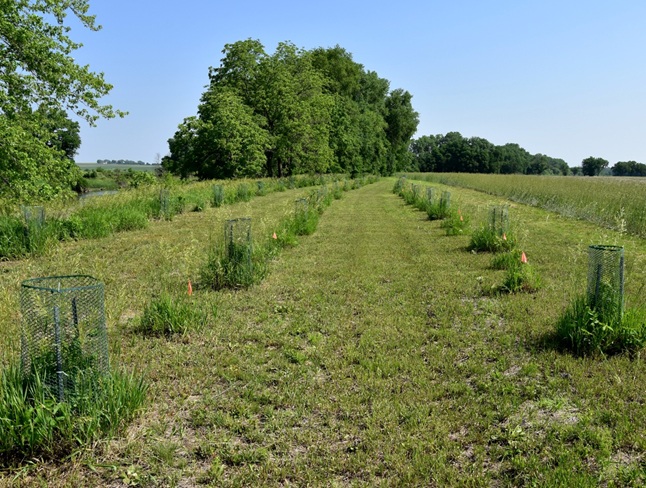
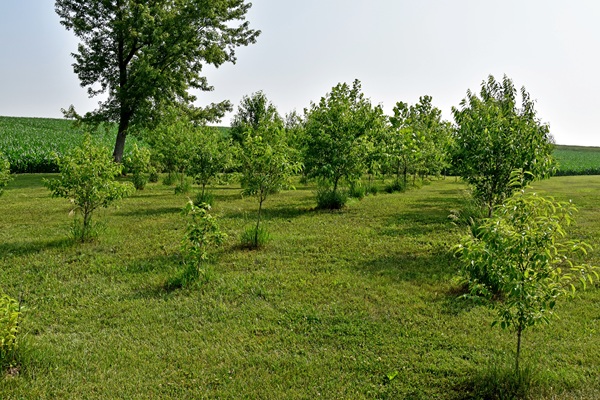
Tree/Shrub Establishment1 is the establishment of woody plants by seeding, seedlings or cuttings, or through natural regeneration.
Key aspects and considerations:
- Use fertilizers to maintain plant vigor.
- Choose plant material adapted for each site.
- Select species based on site characteristics and goals.
- Manage for weeds and predators.
- Thin and prune as needed.
- Combine with other conservation practices, such as windbreaks, riparian buffers, and agroforestry systems, to increase effectiveness.
Benefits and Limitations
| ACRE Category | Benefits | Limitations |
|---|---|---|
| Soil Health |
|
|
| Water Management |
|
|
| Nutrient Management |
|
|
| Agricultural Production |
|
|
| Biodiversity and Wildlife |
|
|
| GHG Emission |
|
|
| Economics |
|
|
Impact on Agricultural Resilience
- Shade provided by trees and shrubs helps to regulate temperature and enhance the resilience of agricultural systems.
- Combining Tree/Shrub Establishment with other NRCS practices promotes a diverse landscape and long-term ecological resilience.
Regional Applicability
- Openlands provides information about important characteristics of 10 Native Trees and Shrubs for Landscaping in the Midwest.
- The USDA published the Wisconsin Guidance Document 612 (2022) Tree/Shrub Establishment Planting Guide, to be used by professionals as a guide for adopting Conservation Practice Standard 612, though it can also be applied to other practices.
- In a Fact Sheet Series, the National Center for Appropriate Technology (NCAT ATTRA) gives guidelines for Tree and Shrub Establishment at Central and Southern Appalachian Region.
Resources
- Video. USDA-NRCS: Tree Shrub Establishment
- Video. NCAT ATTRA: NRCS Practice 612. Tree and Shrub Establishment
- Minnesota Board of Water and Soil Resources: CPS 612 Tree/Shrub Establishment Training Series
- Fibershed Quick Guide: Tree and Shrub Establishment (CPS 612)
- Pennsylvania NRCS: Practice Guide for Tree/Shrub Establishment
- Alliance to Advance Climate-Smart Agriculture: Alliance Practice Worksheet Minnesota, Tree and Shrub Establishment (612)
References
- USDA-NRCS (2023). Conservation Practice Standard Document, Tree/Shrub Establishment, Code 612. https://www.nrcs.usda.gov/sites/default/files/2023-08/612_NHCP_CPS_Tree-Shrub_Establishment_2023.pdf
- NCAT ATTRA Sustainable Agriculture (2024). Tree and Shrub Establishment: Central and Southern Appalachian Region. https://www.ncat.org/publication/tree-and-shrub-establishment-central-and-southern-appalachian-region/
- USDA-NRCS (2023). Conservation Practice Overview, Tree/Shrub Establishment, Code 612. https://www.nrcs.usda.gov/sites/default/files/2023-08/612_NHCP_PO_Tree-Shrub_Establishment_2023.pdf
- USDA-NRCS (2020). Conservation Practice Standard Document, Tree/Shrub Site Preparation, Code 490. https://www.nrcs.usda.gov/sites/default/files/2022-10/Tree_Shrub_Site_Preparation_490_CPS_10_2020.pdf