Vegetative Barriers (NRCS #601)
Applicable Systems
About
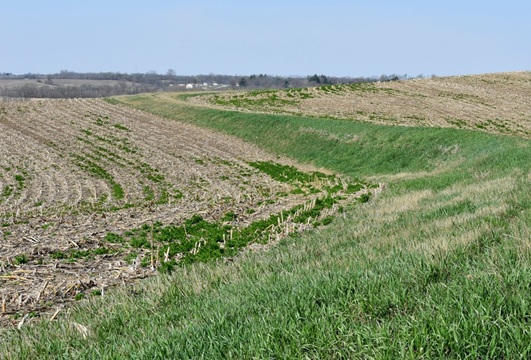
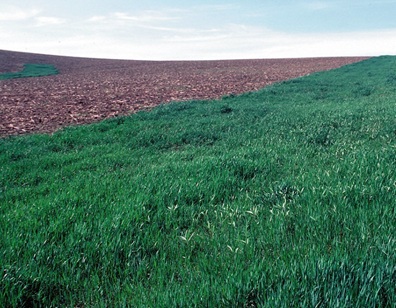
Vegetative barriers are implemented when perennial vegetation is planted in narrow rows along contour slopes or areas prone to high water flows1 2. Vegetative barriers can be planted in-field or at the edge-of-field3. Unlike other conservation buffer practices, vegetative barriers may form terraces or soil berms, which are created and maintained when fields are tilled. Vegetative barriers reduce erosion and trap sediment, though additional benefits are possible depending on species selection and site characteristics. Specific management considerations such as buffer length, number of rows, and gradient will depend on site characteristics and land manager goals4.
Key aspects and considerations:
- Select stiff perennial vegetation (refer to the Vegetation Stiffness Index, or VSI).
- During the first growing season, limit gaps between plants to 3 inches.
- Select species based on local soil and climate, as well as growth and management characteristics. Ideal species will be low maintenance, easily established, and long-lived.
- Avoid mowing to maintain the vegetation stiffness index.
- Plant barriers either in-field or at edge-of-field.
- Add vegetative barriers to existing strip cropping, filter strips, riparian forest buffers, or grassed waterways to increase effectiveness.
Benefits and Limitations
| ACRE Category | Benefits | Limitations |
|---|---|---|
| Soil Health |
| |
| Water Management |
| |
| Nutrient Management |
|
|
| Agricultural Production |
|
|
| Biodiversity and Wildlife |
|
|
| GHG Emission |
| |
| Economics |
|
|
Impact on Agricultural Resilience
- Vegetative barriers help mitigate the impacts of extreme rainfall by increasing infiltration, reducing runoff, and disrupting concentrated flows.
- Vegetative barriers also reduce the speed of runoff, which results in sediment deposited upslope, which helps to reduce the steepness of the slope between barriers, making the land more resilient to future extreme rain events.
Regional Applicability
- Vegetative barriers are applicable across the Midwest but are most needed in areas with sloped land, such as the Driftless Area of the Upper Midwest.
- In the Midwest, the economic benefits of vegetative barriers may outweigh the costs, reducing the barriers to implementation. Past work in a Missouri watershed estimated the cost of a buffer at $62 per acre annually, while the annual benefit was estimated at $73 (estimate is based on CRP land rental rate and 50% cost share for installation)8.
Resources
- Cooperative Extension & Outreach, University of Guam: Vegetative Barrier
- University of Missouri Extension: Vegetative Barriers for Erosion Control
- Colorado State University: Controlling Soil Erosion from Wind
- Gulf Hypoxia and Local Water Quality Concerns Workshop Final Report: Buffers and Vegetative Filter Strips
- The Morton Arboretum: Vegetation Barrier Toolkit for Schools and Communities
- USDA-NRCS Technical Note: Selecting, Planting, and Managing Grasses for Vegetative Barriers
- USDA-NRCS: Vegetative Barrier - Small Scale Solutions for Your Farm
- Video. USDA-NRCS: Vegetative Barrier
References
- USDA-NRCS (2021). Conservation Practice Standard Document, Vegetative Barrier, Code 601. https://www.nrcs.usda.gov/sites/default/files/2022-10/Vegetative_Barrier_601_NHCP_CPS_2020.pdf
- USDA-NRCS (2021). Conservation Practice Overview, Vegetative Barrier, Code 601. https://www.nrcs.usda.gov/sites/default/files/2022-10/Vegetative_Barrier_601_NHCP_PO_2020.pdf
- Helmers, M. J., Isenhart, T. M., Dosskey, M., Dabney, S. M., & Strock, J. S. (2008). Buffers and vegetative filter strips.
- Gene, S. M., Hoekstra, P. F., Hannam, C., White, M., Truman, C., Hanson, M. L., & Prosser, R. S. (2019). The role of vegetated buffers in agriculture and their regulation across Canada and the United States. Journal of Environmental Management, 243, 12-21.
- Bonner, I. J., Muth Jr, D. J., Koch, J. B., & Karlen, D. L. (2014). Modeled impacts of cover crops and vegetative barriers on corn stover availability and soil quality. BioEnergy Research, 7(2), 576-589.
- Blanco-Canqui, H., Gantzer, C. J., Anderson, S. H., Alberts, E. E., & Thompson, A. L. (2004). Grass barrier and vegetative filter strip effectiveness in reducing runoff, sediment, nitrogen, and phosphorus loss. Soil Science Society of America Journal, 68(5), 1670-1678.
- Swan, A., Oldfield, E., & Toureene, C. (2025). Perennial Plantings and Climate Outcomes: Literature Review and Technical Guidance. Technical Advisory Network for Climate Smart Agricultural Practices. https://doi.org/10.5281/zenodo.15777153
- Qiu, Z. (2003). A VSA-based strategy for placing conservation buffers in agricultural watersheds. Environmental Management, 32(3), 299-311.