Contour Buffer Strips (NRCS #332)
Applicable Systems
About
Contour buffer strips1 are a conservation buffer primarily planted to reduce sheet and rill erosion, improve water quality, and enhance soil moisture. Prairie grasses or other perennial, herbaceous vegetation are planted in narrow strips around the hill slope between regularly spaced, wider cropped strips that are farmed on the contour.
Key aspects and considerations:
- When designing contour buffer strips, consider species selection, climate, topography, soil type, and erosion potential1.
- Contour buffers are most effective on slopes between 2-10%.
- Plant strips in rows at least 15 feet wide, in parallel strips for easier access.
- Use deep-rooted grasses to maximize nutrient interception.
- Avoid using strips as travel lanes for equipment or livestock.
- Contour buffer strips require establishment and maintenance of dense and continuous vegetation2, with ground cover above 65% on headlands and end row areas.
- Less effective when slopes exceed 10% and on topography with rolling hills and irregular slopes.
Benefits and Limitations
| ACRE Category | Benefits | Limitations |
|---|---|---|
| Soil Health |
|
|
| Water Management |
|
|
| Nutrient Management |
|
|
| Agricultural Production |
|
|
| Biodiversity and Wildlife |
|
|
| GHG Emission |
|
|
| Economics |
|
|
Impact on Agricultural Resilience
- By reducing sheet and rill erosion, contour buffer strip systems are more resilient to extreme rainfall events.
- Contour buffer strips reduce runoff and increase infiltration, which can enhance soil moisture availability during drought.
Regional Applicability
- Prairie strips established in the form of in-field contour buffer strips have demonstrated how this conservation practice works on different landscapes and soils across the states of Iowa, Minnesota, Missouri, Michigan, Nebraska, South Dakota, Wisconsin, Indiana, Ohio, and Illinois.
Case Studies
- In Rowley, Iowa, Dick Sloan farms 520 acres where he implements a range of conservation practices, including planting contour buffers with prairie strips. "Highly productive farms now, and in the future, are built around systems which protect native species... Farming is so much more than maximizing today's production of corn and soybeans," states Sloan.
- Eric Lee, who farms in the Driftless region of Wisconsin, partnered with NRCS and the Land and Water Conservation Department (LWCD) to implement conservation practices, including contour buffer strips. Describing his decision, Eric states, "This land needed to be farmed differently or it wouldn't be farmed much longer."
Resources
- Video. North Central Region Water Network: ACPF - Lecture 18: Contour Buffer Strips
- Iowa State University: Science-Based Trials of Rowcrops Integrated with Prairie Strips
- University of Missouri Center for Regenerative Agriculture: Conservation Buffers
- USDA-NRCS: Conservation Planning Tools
- University of Northern Iowa: Tallgrass Prairie Center. Prairie on Farms
- Jason Johnson, Iowa NRCS: Contour Buffer Strip album
References
- USDA-NRCS (2014). Conservation Practice Standard Document, Contour Buffer Strips, Code 332. https://www.nrcs.usda.gov/sites/default/files/2022-09/Contour_Buffer_Strips_332_CPS_9-14.pdf
- Helmers, M. J., Isenhart, T. M., Dosskey, M. G., Dabney, S. M., & Strock, J. S. (2008). Buffers and Vegetative Filter Strips (Chapter 4). In Final Report: Gulf Hypoxia and Local Water Quality Concerns Workshop. American Society of Agricultural and Biological Engineers (ASABE), pp. 43-58. https://www.epa.gov/sites/default/files/2015-07/documents/2006_8_24_msbasin_symposia_ia_session4-2.pdf
- Tyndall, J. C., Schulte, L. A., Liebman, M., & Helmers, M. (2013). Field-level financial assessment of contour prairie strips for enhancement of environmental quality. Environmental Management, 52, 736--747. https://doi.org/10.1007/s00267-013-0106-9
- Arora, K., Mickelson, S. K., Baker, J. L., Tierney, D. P., & Peters, C. J. (1996). Herbicide retention by vegetative buffer strips from runoff under natural rainfall. Transactions of the American Society of Agricultural Engineers, 39(6), 2155-2162. https://doi.org/10.13031/2013.27719
- Bailey, N. J., Motavalli, P. P., Udawatta, R. P. & Nelson, K. A. (2009). Soil CO2 emissions in agricultural watersheds with agroforestry and grass contour buffer strips. Agroforestry Systems, 77, 143--158. https://doi.org/10.1007/s10457-009-9218-x
- Dutter, C., Damiano, L. A., Niemi, J., Miller, B. A., Schulte, L. A., Liebman, M., Helmers, M. J., Cruse, R. M., & McDaniel, M. D. (2023). Contour prairie strips affect adjacent soil but have only slight effects on crops. Field Crops Research, 296, 108905. https://doi.org/10.1016/j.fcr.2023.108905
- Miller, T. P., Peterson, J. R., Lenhart, C. F., & Nomura, Y. (2012). The Agricultural BMP Handbook for Minnesota. Minnesota Department of Agriculture. https://www.house.mn.gov/comm/docs/AG-BMPHandbookforMN_09_2012.pdf
- Moorhouse, A. L. (2016). Evaluation of CRP contour buffer and filter strips as habitat for native bees and predatory ground beetles. Thesis, Iowa State University, Ames, IA. https://www.proquest.com/docview/1831376284?pq-origsite=gscholar&fromopenview=true&sourcetype=Dissertations%20&%20Theses
- Qiu, Z. (2003). A VSA-Based Strategy for Placing Conservation Buffers in Agricultural Watersheds. Environmental Management, 32, 299--311. https://doi.org/10.1007/s00267-003-2910-0
- Sahu, M., & Gu, R. R. (2009). Modeling the effects of riparian buffer zone and contour strips on stream water quality. Ecological Engineering, 35(8), 1167-1177. https://doi.org/10.1016/j.ecoleng.2009.03.015
- Schulte, L. A., Niemi, J., Helmers, M. J., Liebman, M., Arbuckle, J. G., James, D. E., Kolka, R. K., O'Neal, M. E., Tomer, M. D., Tyndall, J. C., Asbjornsen, H., Drobney, P., Neal, J., Van Ryswyk, G., & Witte, C. (2017). Prairie strips improve biodiversity and the delivery of multiple ecosystem services from corn--soybean croplands. Proc. Natl. Acad. Sci. U.S.A., 114(42), 11247-11252. https://doi.org/10.1073/pnas.1620229114
- Stephenson, J. A., Liebman, M., Niemi, J., Cruse, R., Tyndall, J., Witte, C., James, D. & Helmers, M. (2024). The influence of prairie strips sown in midwestern corn and soybean fields on sediment discharge throughout the year. Journal of Soil and Water Conservation, 79(2), 87--98. https://doi.org/10.2489/jswc.2024.00037
- USDA-NRCS (2004). Conservation Practice Standard Overview, Contour Buffer Strips (Code 332). https://www.nrcs.usda.gov/sites/default/files/2022-09/Contour_Buffer_Strips_332_Overview.pdf
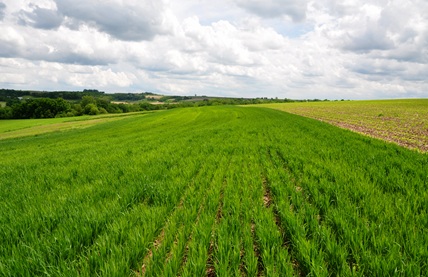
Photo 1: Caption: Contour buffer strips offer a strategy to reduce erosion and retain nutrients on sloped cropland.
Iowa NRCS photo by Jason Johnson.