Strip Cropping (NRCS #585)
Applicable Systems
About
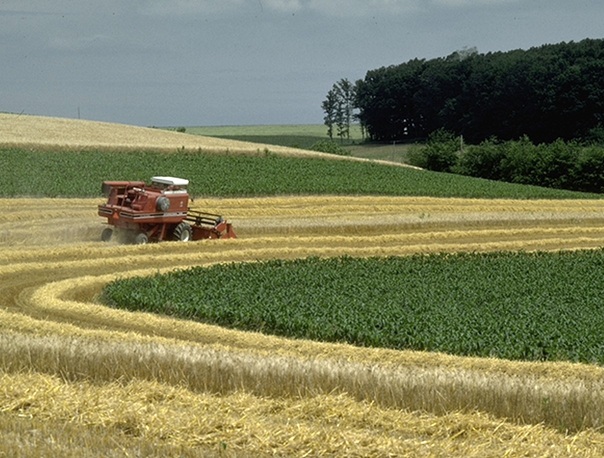
Strip cropping1 is a conservation practice where crops susceptible to erosion and crops resistant to erosion are systematically distributed in alternating strips across a field. Erosion-resistant plants protect strips of plants vulnerable to erosion, thus protecting the soil and improving crop productivity and health. For the greatest effectiveness, strip cropping can be combined with additional conservation practices such as no till or reduced till.
Key aspects and considerations:
- Establish strips in equal widths to the maximum possible extent across the field.
- Ensure at least 50 percent of the strips are planted with erosion-resistant vegetation.
- Maintain dense vegetation to reduce flow velocity and sediment transport.
- Maintain surface cover greater than 75 percent in periods of greatest soil loss potential.
- Distribute accumulated sediments over the field to maintain practice effectiveness.
- Plant strips perpendicular to the prevailing wind direction for wind erosion control in arid and semiarid regions.
- Consider perennial grasses and legumes alternating with grain and row crops for increased effectiveness.
- Avoid implementing on uneven terrain.
- Conduct cost-benefit analysis to consider productivity, maintenance and operational costs.
Benefits and Limitations
| ACRE Category | Benefits | Limitations |
|---|---|---|
| Soil Health |
|
|
| Water Management |
|
|
| Nutrient Management |
|
|
| Agricultural Production |
|
|
| Biodiversity and Wildlife |
|
|
| GHG Emission |
|
|
| Economics |
|
|
Impact on Agricultural Resilience
- Helps to maintain long-term productivity of farmland.
- Improves plants resilience to droughts by increasing water holding capacity.
Regional Applicability
- The USDA-NRCS North Carolina office simulated two scenarios of strip cropping implementation. One scenario aims to control water erosion, and the second one is designed to control wind erosion and the transport of airborne particulate matter from cropland.
Case Studies
- Meet how Dean Sponheim, from Nora Springs, IA, incorporated strip cropping into his and his son's 600-acre farm in 2008. Since adopting the new system, he has seen an increase of 12-15% in corn yield, and $80-$100 per acre in net income over the traditional cropping systems. "We're taking care of the soil differently now, and strip-till is helping us build it back up," says Sponheim.
Resources
- Video. Precision Planting: InsidePTI S4•E13 | Strip Cropping & Cover Crop Grazing
- NC State University: SERA-17, Stripcropping
- Strip-till Farmer: Strip-Cropping Experiments Yielding Economic, Environmental Advantages
References
- USDA-NRCS (2017). Conservation Practice Standard Document, Stripcropping, Code 585. https://www.nrcs.usda.gov/sites/default/files/2022-10/Stripcropping_585_CPS_Oct_2017.pdf
- McNeely, R., Logan, A. A., Obrecht, J., Giglierano, J., & Wolter, C. (2017). Iowa Best Management Practices (BMP) Mapping Project Handbook. https://www.iowaview.org/wp-content/uploads/2018/03/Iowa-Best-Management-Practices-Mapping-Handbook.pdf
- Al-Amin, A. K. M. A., Lowenberg-DeBoer, J., Erickson, B. J., Evans, J. T., Langemeier, M. R., Franklin, K., & Behrendt, K. (2024). Economics of strip cropping with autonomous machines. Agronomy Journal, 116, 572-589. https://doi.org/10.1002/agj2.21536
- Miller, T.P., Peterson, J. R., Lenhart, C. F. & Nomura, Y. (2012). The Agricultural BMP Handbook for Minnesota. Minnesota Department of Agriculture, p.72-74. https://www.house.mn.gov/comm/docs/AG-BMPHandbookforMN_09_2012.pdf
- USDA-NRCS (2017). Conservation Practice Overview, Stripcropping (Code 585). https://www.nrcs.usda.gov/sites/default/files/2022-10/Stripcropping_Overview_585_Oct_2017_final.pdf