Herbaceous Wind Barriers (NRCS #603)
Applicable Systems
About
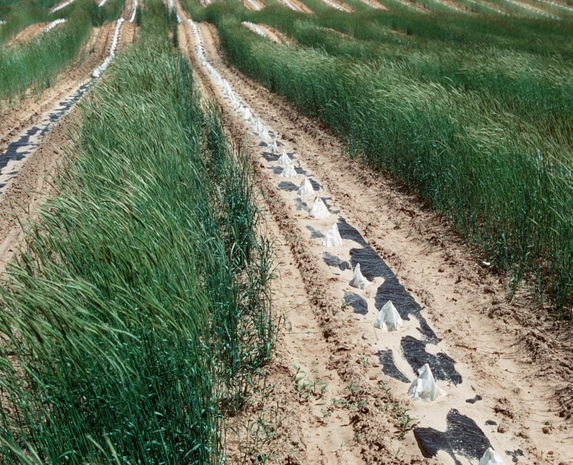
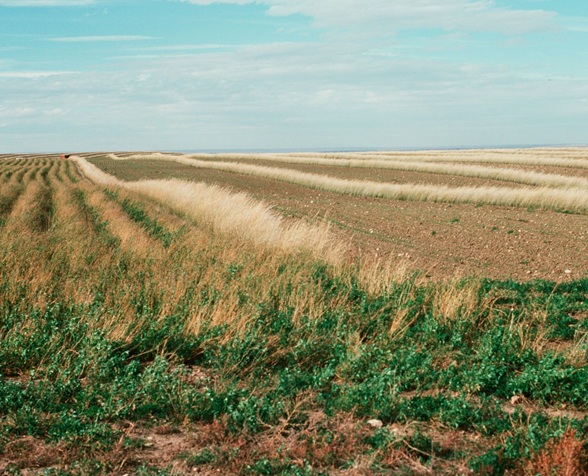
Herbaceous wind barriers1 are narrow strips of herbaceous, non-woody plants spaced across the field perpendicular to the prevailing wind direction. The goal is to reduce wind speed and avoid wind erosion, though additional benefits are possible depending on species selection and site characteristics. In areas with height restrictions such as central pivot irrigation fields, herbaceous wind barriers fit very well.
Key aspects and considerations:
- Orient barriers perpendicularly to prevailing wind direction.
- Ensure barriers are at least 1.5 feet in height.
- Ensure within row spacing is 36 inches or less.
- Establish row spacing to accommodate equipment and management operations.
- Plant stiff vegetation, tolerant to soil deposition.
- Choose species to minimize competition.
- Plant perennial, annual, or a mix of herbaceous vegetation that are adapted to local site conditions.
Benefits and Limitations
| ACRE Category | Benefits | Limitations |
|---|---|---|
| Soil Health |
|
|
| Water Management |
|
|
| Nutrient Management |
|
|
| Agricultural Production |
|
|
| Biodiversity and Wildlife |
|
|
| GHG Emission |
|
|
| Economics |
|
|
Impact on Agricultural Resilience
- Herbaceous wind barriers help to reduce soil drying rates and soil temperature during the summer, and increase soil temperature in early spring4.
- Reduce the impact of heavy rainfall by improving infiltration, reducing runoff, and disrupting concentrated flows.
- Reduce soil loss especially during drought and high-wind events.
- By reducing windspeed, evapotranspiration is reduced, soil retains moisture for longer periods, and crops are more resilient to drought stress.
Regional Applicability
- Herbaceous wind barriers are applicable across the Midwest but are most likely to occur in areas with sloped land, such as the Driftless Area of the upper Midwest.
Resources
- Video. USDA-NRCS: Herbaceous Wind Barrier
- Colorado State University Extension: Wind Erosion Processes and Control
- Utah State University Forest Extension: Modern Windbreaks Fight Drought
References
- USDA-NRCS (2023). Conservation Practice Standard Document, Herbaceous Wind Barrier, Code 603. https://www.nrcs.usda.gov/sites/default/files/2023-08/603_NHCP_CPS_Herbaceous_Wind_Barriers_2023.pdf
- Grantz, D. A., Vaughn, D. L., Farber, R. J., Kim, B., Ashbaugh, L., VanCuren, T. & Campbell, R. (1998). Wind Barriers Suppress Fugitive Dust and Soil-Derived Airborne Particles in Arid Regions. Journal of Environmental Quality, 27, 946-952. https://doi.org/10.2134/jeq1998.00472425002700040031x
- Bruce, M., Walther, D., & Briggs, J. (2008). Herbaceous Wind Barriers for Irrigated Lands in Arizona. Forage and Grain: A College of Agriculture and Life Sciences Report. College of Agriculture, University of Arizona (Tucson, AZ). http://hdl.handle.net/10150/203636
- Black, A. L., & Aase, J. K. (1988). The use of perennial herbaceous barriers for water conservation and the protection of soils and crops. Agriculture, Ecosystems & Environment, 22-23, 135-148. https://doi.org/10.1016/0167-8809(88)90014-X
- USDA-NRCS (2021). Conservation Practice Overview, Herbaceous Wind Barrier (Code 603). https://www.nrcs.usda.gov/sites/default/files/2022-09/Herbaceous_Wind_Barriers_603_Overview.pdf