Filter Strips (NRCS #393)
Applicable Systems
About
Filter strips1 are vegetated areas generally located along the lower edge(s) of fields to protect sensitive areas. They serve as a natural filter that intercept sediments, nutrients, and other constituents from agricultural fields thus protecting water bodies, wetlands and other susceptible area. Many of the benefits associated with filter strips are due to increases in infiltration2. Long-term effectiveness depends on the type of vegetation3, and performance often improves in the years following establishment2.
Key aspects and considerations:
- Design filter strips for a 10-year life span.
- Introduce permanent herbaceous vegetation.
- Select species with high density cover, herbicide tolerant, and ability to withstand partial burial from sediment deposit.
- Consider slopes between 5 and 15% for best effectiveness.
- Plant wider strips for the greatest runoff and sediment reduction4.
- Avoid establishing in areas with a shallow water table, as filter strips will likely be less effective.
Benefits and Limitations
| ACRE Category | Benefits | Limitations |
|---|---|---|
| Soil Health |
|
|
| Water Management |
|
|
| Nutrient Management |
|
|
| Agricultural Production |
|
|
| Biodiversity and Wildlife |
|
|
| GHG Emission |
|
|
| Economics |
|
|
Impact on Agricultural Resilience
- Buffers extreme rainfall and flooding by slowing down runoff and increasing infiltration, making water available for plants in dry periods.
- Reduces soil degradation under drought and heavy rain by improving soil structure.
- Intercepts contaminates (sediment, nutrients, pesticides, pathogens) in field runoff thus protecting soil and water quality.
Regional Applicability
- The NRCS and the Minnesota Department of Agriculture make some recommendations for Filter Strips and Field Border practices to protect soil from erosion and reduce sediments and contaminants into runoff.
- Kansas State Research and Extension shows how vegetative filter strip systems can be applied for controlling and reducing nutrient runoff from confined animal feeding operations into surface water.
- Prairie strips, which are field strips with prairie vegetation, associated with corn and soybean fields in central Iowa, reduced water runoff, increased soil and nutrient retention, as well as birds and pollinators abundance5.
Case Studies
- Across central Iowa, there are many successful case studies implementing prairie strips5, a version of filter strips with prairie vegetation. Planting 10% of fields to prairie strips can reduce sediment and nutrient loss. "The whole key to farming in Iowa is to be able to consistently do the same practice over 2,000 acres in the couple of days mother nature gives you the field conditions you need. Managing that risk is huge and prairie strips is something one could control. You do it, it's there, and you don't have that ongoing seasonal risk as you do with cover crops", states Mollie Aronowitz from The Luze Farm.
Resources
- Video. Iowa NRCS: Conservation Choices Practice Spotlight: Filter Strips
- Video. Sand County Foundation: Prairie Strips webinar#1: A new conservation practice for farmers and crop consultants
- Iowa State University: Science-Based Trials of Rowcrops Integrated with Prairie Strips
- Michigan Conservation Reserve Enhancement Program (CREP). CP 21 - Filter Strips
- Sand County Foundation: Estimating the Water Quality Benefits of Prairie Strips Using SnapPlus
- University of Florida Extension: Vegetative Filter Strips -- A Best Management Practice for Controlling Nonpoint Source Pollution
- USDA National Resources Conservation Service (NRCS) - Using RUSLE2 for the Design and Predicted Effectiveness of Vegetative Filter Strips (VFS) for Sediment
References
- USDA-NRCS (2016). Conservation Practice Standard Document, Filter Strip, Code 393. https://www.nrcs.usda.gov/sites/default/files/2022-09/Filter_Strip_393_CPS.pdf
- Dosskey, M. G., Hoagland, K. D., & Brandle, J. R. (2007). Change in filter strip performance over ten years. Journal of Soil and Water Conservation, 62(1), 21-32. https://doi.org/10.1080/00224561.2007.12435916
- Lee, K-H., Isenhart, T. M., Schultz, R. C. & Mickelson, S. K. (1998). Nutrient and sediment removal by switchgrass and cool-season grass filter strips in Central Iowa, USA. Agroforestry Systems, 44, 121--132. https://doi.org/10.1023/A:1006201302242
- Douglas-Mankin, K. R., Helmers, M.J., & Harmel, R.D. (2021). Review of Filter Strip Performance and Function for Improving Water Quality from Agricultural Lands. Transactions of the ASABE, 64(2), 659-674. https://doi.org/10.13031/trans.14169
- Schulte, L. A., Niemi, J., Helmers, M. J., Liebman, M., Arbuckle, J. G., James, D. E., ... & Witte, C. (2017). Prairie strips improve biodiversity and the delivery of multiple ecosystem services from corn--soybean croplands. Proceedings of the National Academy of Sciences, 114(42), 11247-11252. https://doi.org/10.1073/pnas.1620229114
- NPDES: Stormwater Best Management Practice -- Vegetated Filter Strip. https://www.epa.gov/system/files/documents/2021-11/bmp-vegetated-filter-strip.pdf
- USDA-NRCS (2016). Conservation Practice Standard Overview, Filter Strip (Code 393). https://www.nrcs.usda.gov/sites/default/files/2022-09/Filter_Strip_393_Overview_Sep_2016.pdf
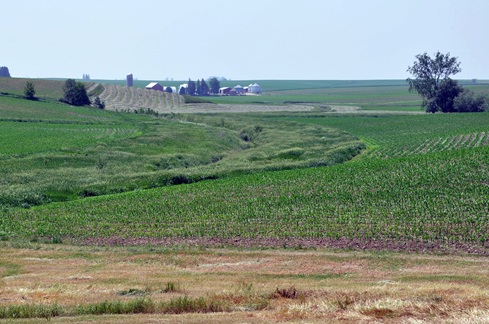
Photo 1: Filter strip along a field in Dubuque County, Iowa.
Courtesy of Iowa NRCS photo by Jason Johnson.
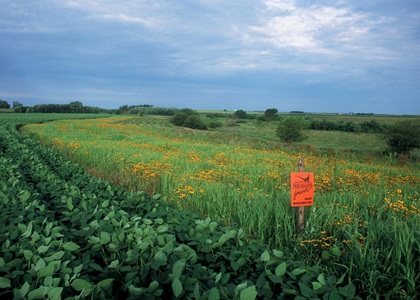
Photo 2: When planted with appropriate species, filter strips can provide pollinator and wildlife habitat.
Courtesy of Iowa NRCS photo by Jason Johnson.
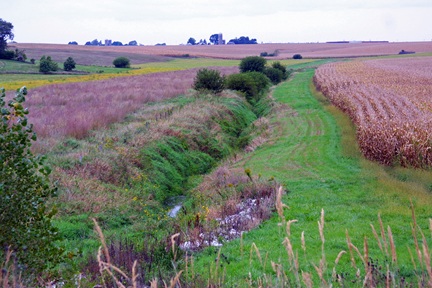
Photo 3: A filter strip along the two sides of a creek in an Iowa field.
Courtesy of Iowa NRCS photo by Jason Johnson.