Conservation Crop Rotation (NRCS #328)
Applicable Systems
About
Conservation crop rotation refers to the practice of planting a sequence of different crops on the same field over multiple growing seasons. A minimum of two different crops must be planted in a crop rotation. Perennial crops and crops high in residue are often most effective at improving soil health. Extended crop rotations often include small grains or forage. Benefits of conservation crop rotations include decreased soil erosion, improved soil stability, improved soil organic matter quality, and enhanced soil habitat1 2. In terms of economics, costs and revenue will vary depending on agronomic and market responses.
Key aspects and considerations:
- For better overall benefits, consider crop rotations lasting four years or longer.
- Plant the same crop for a maximum of two consecutive years.
- Select crops based on management goals, nutrient and water needs, crop family, site conditions, available equipment and labor, and climate.
- Consider herbicide rotational restrictions, and the risk of herbicide carryover.
Benefits and Limitations
| ACRE Category | Benefits | Limitations |
|---|---|---|
| Soil Health |
|
|
| Water Management |
| |
| Nutrient Management |
|
|
| Agricultural Production |
| |
| Biodiversity and Wildlife |
| |
| GHG Emission |
|
|
| Economics |
|
|
Impact on Agricultural Resilience
- Crop rotations disrupt pests, weeds, and disease cycles, which make cropping systems more resilient to change as species ranges shift.
- Additionally, by protecting soil from erosion, crop rotations increase resiliency to high wind and large rain events.
- Deep-rooted perennials, such as forages, may be more resilient to drought due to increased ability to take up water.
- By growing a diversity of crops, farmers and producers are more resilient to disease, pest, and climate impacts.
Regional Applicability
- Conservation crop rotations are applicable across the Midwest, both in large agricultural fields and in home gardens. In the Midwest, the most common crop rotation is corn-soybean, making up 65% of cropland in the region7. In Illinois, common 3-year rotations include corn, soybean, and wheat. Extended crop rotations incorporating small grains and forage were at one time prevalent in the Upper Midwest, but have since declined with changes in socioeconomics, technology, and a decrease in integrated crop-livestock systems6.
- Previous research conducted in the Midwest highlights both yield and economic benefits of crop rotations. A recent study out of the University of Illinois found that corn-soybean rotations increased economic returns by up to $458 per acre compared to continuous corn, but the economic return varied based on both fertilizer application rate and market prices. In Ohio, long-term diversified crop rotations improved corn yield. Additionally, incorporating alfalfa into rotation may increase corn profit by $300 per acre due to reduced fertilizer costs.
- However, despite observed benefits of diverse crop rotations, simplified cropping systems continue to dominate the Midwest10.
Case Studies
- In Green, WI, Jake Kaderly implements conservation crop rotations on his farm, managing a 3-year rotation of corn, soybean, and winter wheat -- as well as integrating cover crops into his rotation. The farm has won corn and wheat yield contests, and organic matter has increased by 0.5% across fields.
- In collaboration with an Iowa farmer, Practical Farmers of Iowa explored the return on investment between a 3-year conservation cover rotation, a 2-year corn-soy rotation, and a continuous corn rotation. Analysis found that including a hybrid rye in rotation increased profit.
Resources
- Cornell Cooperative Extension: Rotating Vegetables by Family
- University of Wisconsin Extension: Using Crop Rotation in the Home Vegetable Garden
- University of Wisconsin Extension: Small Grains Economics
- University of Illinois Extension: Cropping Systems and Alternative Crops
- University of Kentucky: Center for Crop Diversification Resources
- The Center for Regenerative Agriculture and Resilient Systems: Crop Rotation Fact Sheet
- USDA-NRCS Fact Sheet: Conservation Crop Rotations for Specialty Crops
- Video. USDA-NRCS: Conservation Crop Rotation
- Video. Practical Farmers of Iowa: Crop Rotations for Weed Suppression
References
- USDA-NRCS (2014). Conservation Practice Standard Document, Conservation Crop Rotation, Code 328. https://www.nrcs.usda.gov/sites/default/files/2022-09/Conservation_Crop_Rotation_328_CPS.pdf
- USDA-NRCS (2014). Conservation Practice Standard Overview, Conservation Crop Rotation, Code 328. https://www.nrcs.usda.gov/sites/default/files/2022-09/Conservation_Crop_Rotation_328_Overview.pdf
- King, A. E., & Blesh, J. (2018). Crop rotations for increased soil carbon: perenniality as a guiding principle. Ecological Applications, 28(1), 249-261.
- Tiemann, L. K., Grandy, A. S., Atkinson, E. E., Marin-Spiotta, E., & McDaniel, M. D. (2015). Crop rotational diversity enhances belowground communities and functions in an agroecosystem. Ecology Letters, 18(8), 761-771.
- Qi, Z., & Helmers, M. J. (2010). Soil water dynamics under winter rye cover crop in central Iowa. Vadose Zone Journal, 9(1), 53-60.
- Weisberger, D. A., McDaniel, M. D., Arbuckle, J. G., & Liebman, M. (2021). Farmer perspectives on benefits of and barriers to extended crop rotations in Iowa, USA. Agricultural & Environmental Letters, 6(2), e20049.
- Li, Z., Guan, K., Zhou, W., Peng, B., Nafziger, E. D., Grant, R. F., et al., & Jia, M. (2025). Comparing continuous-corn and soybean-corn rotation cropping systems in the US central Midwest: Trade-offs among crop yield, nutrient losses, and change in soil organic carbon. Agriculture, Ecosystems & Environment, 393, 109739.
- Beillouin, D., Ben-Ari, T., Malézieux, E., Seufert, V., & Makowski, D. (2021). Positive but variable effects of crop diversification on biodiversity and ecosystem services. Global Change Biology, 27(19), 4697-4710.
- Behnke, G. D., Zuber, S. M., Pittelkow, C. M., Nafziger, E. D., & Villamil, M. B. (2018). Long-term crop rotation and tillage effects on soil greenhouse gas emissions and crop production in Illinois, USA. Agriculture, Ecosystems & Environment, 261, 62-70.
- Socolar, Y., Goldstein, B. R., de Valpine, P., & Bowles, T. M. (2021). Biophysical and policy factors predict simplified crop rotations in the US Midwest. Environmental Research Letters, 16(5), 054045.
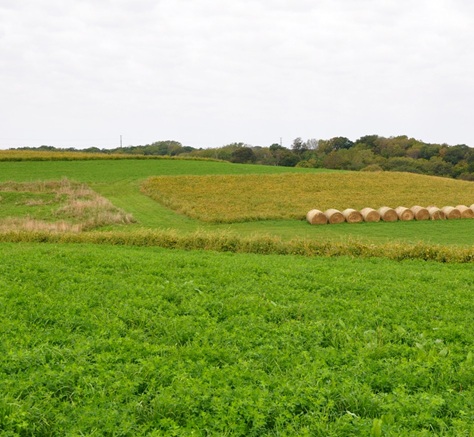
Photo 1: By including alfalfa into the crop rotation, a farmer in central Iowa implements conservation crop rotations.
Photo courtesy of Iowa NRCS.
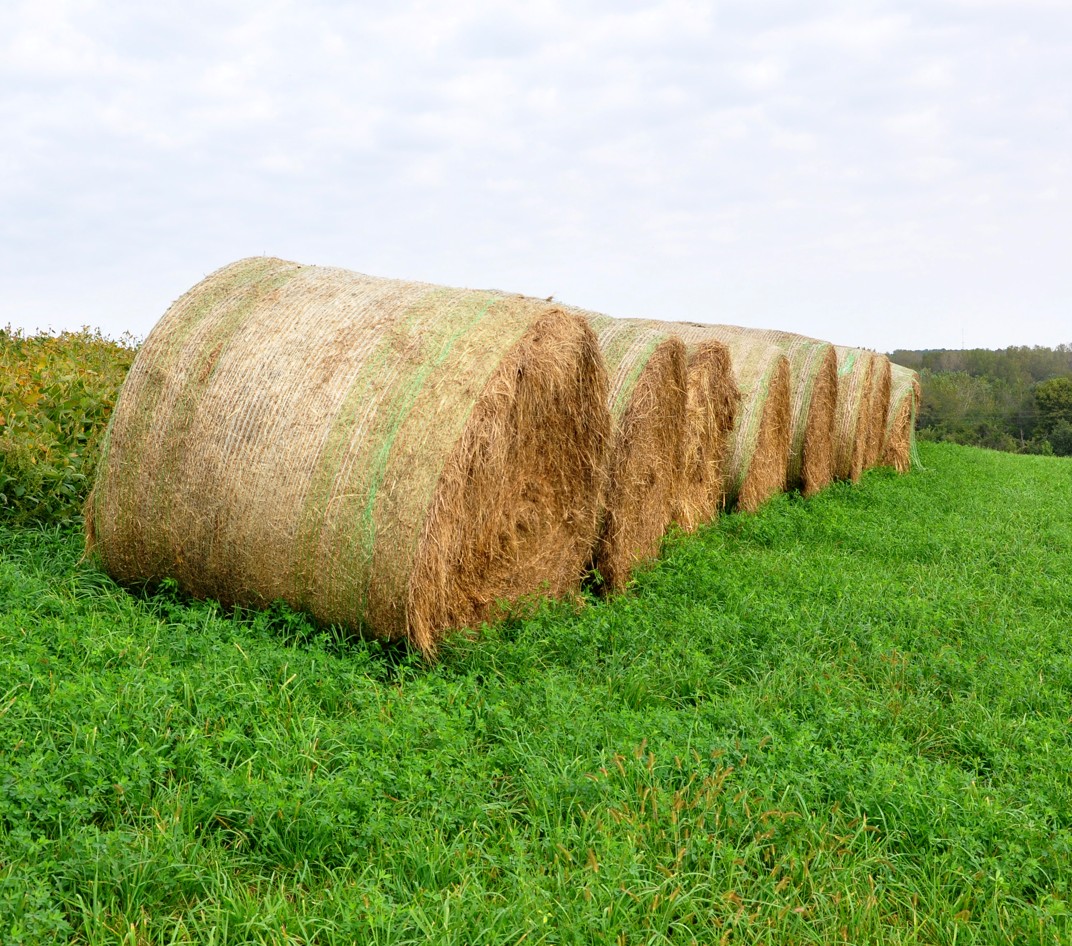
Photo 2: A hay bale sits in a field. When rotated with at least one additional crop, hay can be part of a conservation crop rotation.
Photo courtesy of Iowa NRCS.